Tuesday, April 28, 2020

The remnants of the wall that surrounded Beijing, China


The fortification walls, both an inner wall and an outer wall, surrounding Beijing city were built from the early 1400s to 1553.
The dimensions of the Inner city wall are:
          Length: 24 kilometers or 15 miles
          Height: 25 meters or 49 feet high
          Thickness, at ground level: 20 meters or 66 feet
                            at the top: 12 meters or 29 feet
It had nine gates.  The fortifications included gate towers, archways, watchtowers, barbicans, barbican towers, sluice gates, sluice gate towers, enemy sighting towers, corner guard towers, and a moat system.
The outer city wall had a length of 28 kilometers or 17 miles.
From 1911, after the collapse of the Qing Dynasty, the dismantling of the fortifications began.

In 1965, major deconstruction of the fortifications was commenced to allow for the construction of the 2nd wrong road, and Line 2 or the Beijing underground railway.

 In 1979, the government called off the demolition of the remaining city walls and named them cultural heritage sites. By this time, the only intact sections were the gate tower and watchtower at Zhengyangmen, the watchtower at Deshengmen, the guard tower at the southeast corner, the northern moats of the Inner city, the section of the Inner city wall south of the Beijing railway station, and a small section of Inner-city wall near Xibianmen.


As for our guide's explanation of the fortifications:

Leaving the Square to go to the Golden Mask Dynasty Show, we pass remnants of the wall that used to surround Beijing.


This wall was built in the early 15th century and was about 24 km long, up to 15 meters high and about 20 meters thick, and had nine gates, one of which still exists today.  In 1965 most of it was removed so that the second ring road and an underground railway line could be built.


Friday, April 24, 2020

The Golden Mask Dynasty Show, Beijing, China

The Golden Mask Dynasty Show was located at the OCT Theatre in Beijing's Happy Valley. 

The theatre was quite full and the seats we had were directly behind the VIP area; as our guide told us, we had the best seats in the house. 

The play has 20 different dance scenes that depict war, royal banquets, and romance.  There are eight chapters and over 200 actors, and throughout the performance we were entertained by dancers, acrobats, costumes, lighting, and acoustics.

The story:

It is of romantic legend and historical memories, the Golden Mask Queen leads her army in defeating the invading Blue Mask King's army, and afterwards the lands return to a leisurely pastoral life until the Queen forges a 'mysterious tree'.  When the tree has grown, the Queen has a grand celebration, and releases the captured Blue soldiers, much to the admiration of the Blue Mask King.
This is followed by monstrous floods, and to save her people, and on the advice from the 'mysterious tree', the Queen sacrifices herself to save her people.  The Queen then turns into a golden sunbird flying in the sky blessing the people and that of the dynasty.


Billed as the best live show in China, described as a large scale dramatic musical, “The Golden Mask Dynasty” it lived up to its reputation and was thoroughly enjoyed by all.


It was not just singing dancing and acrobatics, it had a story and it was told so that language and cultural issues aside, it worked.  There was a narration of the story running beside the stage, but it was hard to divide attention between what was happening, and what was being related.


Then came the peacock dance, with live peacocks


And this was followed by a waterfall, well, I don't think anyone in that audience could believe what they were seeing.


I know I was both astonished and in awe of the performance.

What a way to finish off our first day in Beijing.

Oh, sorry, that high was dented slightly when we had to go back to our room.


Tuesday, March 31, 2020

Tiananmen Square, Beijing, China


Tiananmen Square

Some interesting facts before we get out of the bus...

Tiananmen Square or Tian'anmen Square is in the centre of Beijing name after the Gate of Heavenly Peace, a gate that one separated the square from the Forbidden City.

The Square contains,

   the Monument to the People's Heroes
   the Great Hall of the People
   the National Museum of China
   the Mausoleum of Mao Zedong.

The square is about 109 acres and was designed and built in 1651, and since then been enlarged four times since, the most recent upgrade in the 1950s.

The Monument to the People's Heroes

This is a ten-story obelisk built to commemorate the matters of the revolutions.  It was built between August 1952 and May 1958.  On the pedestal are reliefs depicting the eight major revolutionary episodes.

The Great Hall of the People

This was opened in September 1959, and covers 171809 square meters.  The Great Hall is the largest auditorium in China and can seat up to 10,000 people.  The State Banquet Hall can seat up to 5,000 diners.

The National Museum of China

This is one of the largest museums in the world and the second most visited museum in the world after the Louvre in Paris.   It was completed in 1959, and sits on 65 hectares, and rises four floors.  It has a permanent collection of over 1,000,000 items.

The Mauseloum of Mao Zedong

This was built shortly after his death, and completed on May 24th, 1977.  The embalmed body of the Chairman is preserved and on display in the center hall.

My own observations

This is huge; one of the largest public squares in the world, and if you're going to walk it, like we did, make sure you've been exercising before you go.  It covers 44 hectares, borders on the Forbidden City, and has a memorial to Chairman Mao in the center of it.  But you cannot go near it, it's fenced off, and it is guarded.


That's both the statue and the square as there are random guards marching in random directions all the while watching us to see that we don't misbehave.
No one wants to find out what would happen if you jumped the fence around the statue, but I'm guessing you'll have a few years to contemplate the stupidity of your actions with some very unhappy government officials.

           Around the edges of the square are huge buildings, on one side is the museum 


           and on the other is the Chinese equivalent of parliament.


           Around the sides are also large gardens


At one end, where the Forbidden City borders on the square, there's a huge flag pole flying the Chinese flag, and this too like the monument is fenced off, and guarded by members of all of their armed services.  No tanks rolled out during our visit much to our disappointment.  There is no entrance to the Forbidden City from the square

             At the other end is the Mausoleum of Mao Zedong, which was closed the day we were there, as was the museum. 

            There are four sculptural groups installed outside the mausoleum.

          Other than that, it's just another square, albeit probably one of the largest in the world.  It can, we were told, hold about a million people.

Monday, March 23, 2020

The Longjing Pearl Factory, Beijing, China


The Longjing Pearl Factory is located at:
No.2 Zuoan Gate Inner Street, ChongWen District, Beijing 100061 China.

This Pearl Center specializes in both freshwater and seawater pearls, with a reputation backed by the government of China, with a big selection and of the highest quality.  There were all kinds of jewelry made of pearls in different colors, shapes, and sizes.  
They also had, as an interesting sideline, famous Chinese traditional cosmetics such as pearl cream and pearl powder, reputed to make your skin smoother, tendered and most importantly, younger.
We were advised of all of this well before we arrived at the factory, and of course, one suspected the glowing review, with emphasis on the fact it was a government operation and therefore trustworthy, suggested we should buy, meant the tour guide would receive a commission on each sale.
This is nothing new, it's the same the world over, so it's up to the visitor to buy or not to buy.

As soon as you get in the door you are taken to the group's guide for the tour (and afterward, available for help on making purchases). who gives you a rundown on the different types and colors of pearls.  This briefly is,
Pearls come in two main categories: freshwater cultured pearls and saltwater cultured pearls. Various types of pearls are the result of the environment in which they live, and different cultivation techniques used by the pearl farmers. 
Freshwater cultured pearls are grown in lakes and rivers, whereas saltwater cultured pearls are grown in bodies of saltwater such as bays.  The most commonly used pearls are Freshwater pearls.  
Freshwater Pearls come in various pastel shades of white, pink, peach, lavender, plum, purple, and tangerine.  
South Sea cultured pearls come in shades of lustrous white, often with silver or rose overtones. 
Black pearls are known as Tahitian pearls and come most often in shades of black and gray. While a Tahitian pearl has a black body color, it will vary in its overtones, which most often will be green or pink.
Then there's a demonstration, where one of the tour group is selected to pick an oyster out of the tank, and then there's the guessing game as to how many pearls are in the shell, with the winner getting a pearl.

Guesses ranged from 1 to 23 and the answer was 26.  Nearest wins, and one for the person who picked the oyster out of the tank.  After this demonstration, we move on to the ways we can tell the difference between real and fake pearls.
It seems strange that they would, but we were guaranteed by both the tour guide and the lady delivering the lecture that the pearls we were about to buy were real, so how could we suspect there was anything dodgy about them?  Besides, now we could tell real from fake!
We then move onto the showroom floor where there are casements of pearl products, in the form of necklaces, earrings, and any number of variations and uses.  And, just to let you know, the prices are very, very expensive, even if they say they have a special.
Perhaps the best products, and those that found favor with many of the women on the tour, was the pearl crames and powders.  These were not expensive, and, as we discovered later, actually worked as described.


On the road to Tiananmen Square, Beijing, China


One the first things you notice when driving around Beijing, other than the roads are congested with traffic, is the number of trees and flowers that have been planted, in the median strip as well as along the edges of the road.


What you also notice is the large number of multi-story apartment blocks, which are needed to house the millions of Beijing residents.  What we have, so far, rarely seen, is single-story houses.
These continuous areas of trees and rose bushes are, every now and then, broken up by very colorful garden beds:


Nearer to the square we are able to get up close to the flowers.  These, we are told, are a variation on the rose, one that flowers for nine months of the year.


They come in a variety of colors.


And they are literally everywhere you go, on the side of the roadway, often blotting out the concrete jungle behind them.


Monday, March 16, 2020

The Beijing Zoo, Beijing, China

Beijing Zoo

Founded in 1906 during the late Qing dynasty, it is the oldest Zoo in China.  It also has an aquarium and has 450 land-based species, some of which are rare and endemic to China like the Giant Panda, and 500 marine-based species.  Other rare animals to be seen are the Red Panda, the Golden Snub-nosed Monkey, the South China Tiger, the White Lipped deer, the Chinese alligator, the Yak,, and the Snow Leopard.
Most of the original animals were bought in 1908 from Germany by the viceroy of Liangjiang Duanfang.  The Zoo first opened on June 16th, 1908.
Currently, the Zoo grounds resemble classical Chinese gardens, and among the attractions are a number of Qing dynasty buildings to view, as well as an Elephant hall, a Lion and tiger hall, a Monkey hall, and a Panda hall.  In all, there are 30 halls.
The Zoo is located at 137 Xizhimen WaiDajie in Xicheng district, near the 2nd ring road.

We are primarily at the Zoo to see the Pandas, and there is a specific hall devoted to them, and by the way, it costs extra to see them.  Everyone in our group is particularly interested in seeing them because it's rare that any can be found anywhere else in the world.
Perhaps if there had been more time, another hour, maybe, it might have made all the difference, but I think that extra time might have clashed with the pearl factory, and that, for obvious reasons, was deemed to be more important.

Our first stop is in the Panda hall.


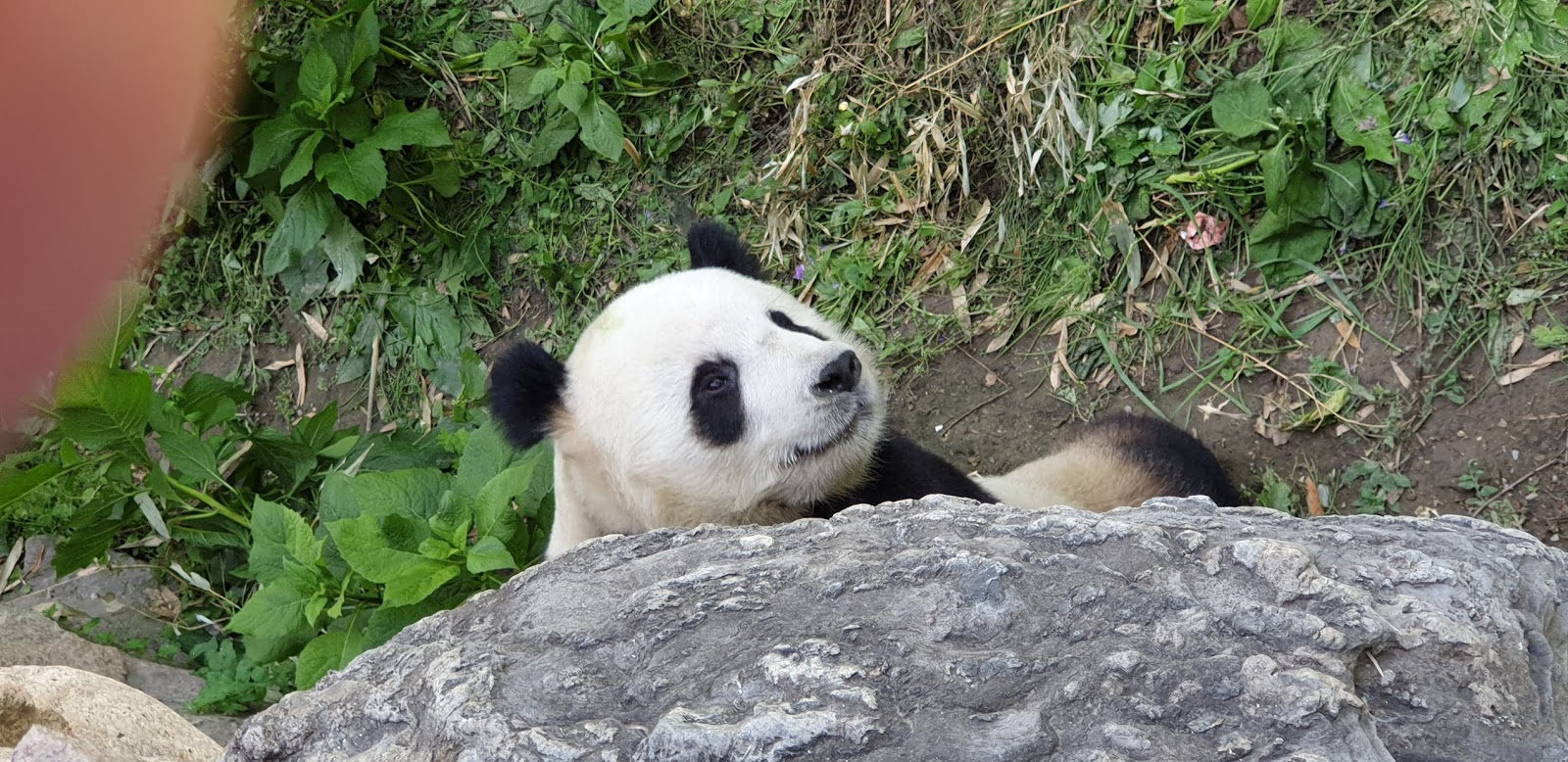
There are two pandas that we can see, one of whom is a little camera shy, and the other, above, who is demonstrating how pandas eat bamboo.  They are behind a large glass wall, and you have to wait for the opportunity to get a good photo, and, sometimes only enough to include the top of the head of the person in front of you.  Unfortunately, the Chinese visitors don't understand the polite excuse me in English, and, can at times, be rude enough to shove their way to the front.


What is also a problem is the uncooperativeness of the pandas to pose for photos.  I guess there's no surprise there given the thousands of visitors every day with only one purpose in mind.  We counted ourselves lucky to get the photos we did.

The hall itself is built on to the external enclosure where there are a number of giant pandas some of whom that were on show were relatively lethargic, as though they had a big weekend, and we're sleeping it off, like this panda below:

Then, remarkably, we came across one that decided to be a little more energetic and did a walk in front of hundreds of Chinese who had undoubtedly come to show their children the animals.


This Panda was also easier to photograph whereas the other panda, one chewing on a morning feast of bamboo, saw a lot of pushing and shoving by the spectators to get the best spot to take his photograph.  Having manners just doesn't cut it here, so do what you have to to get that photograph.


We also saw a couple of monkeys that were also in the panda enclosure, but they were not much of a side benefit.  They may have been there to use the Panda's exercise equipment, though it was not quite like what we use.
There was no time really to wander off to see much else, but apparently, there were also red pandas, and surprisingly, a category call Australian animals.  But, who goes to another country to view your own animals?
The cutest animals were the stuffed pandas, and they were quite reasonably priced.


Wednesday, March 11, 2020

The Beijing Friendship Hotel

The hotel according to their website:  http://grandbuilding.beijingfriendshiphotel.com/info/

The Friendship Hotel was built in 1954 to house foreigners; refurbished in 2002, and these days it relies more on tour groups.  Many of its rooms, done in a traditional Chinese style, are in need of renovation and more up-to-date furnishings.

The Beijing Friendship Hotel Grand Building is located in China's Silicon Valley-Zhongguancun Science and Technology Park, close to the major universities and research institutions in Beijing. Jinyuan Lufthansa Shopping Center, Contemporary Shopping Center, Shuangan Shopping Center are within easy reach, and the transportation is convenient.  

Each room is equipped with an LCD TV, broadband Internet access, a minibar, and more. The Deluxe Executive Room is equipped with a personal multifunction fax machine.

We did not get a Deluxe Executive Room.

And, unfortunately, there were no photographs on their site that matched the room we were given.  They were only of deluxe and business rooms only.

 The Friendship Hotel of Beijing is one of the largest garden-style hotels in Asia. The Friendship Hotel neighbors many world-famous tourist sites and universities such as Tsinghua and Peking University, the Summer Palace.   

It covers a total area of 335,000 square meters of land in the capital city, of which 200,000 square meters are landscaped gardening in the traditional Chinese garden style. The Friendship Hotel of Beijing represents classic Chinese architectural elegance and presents the most pleasurable views.  

There are more than 1,757 guestrooms, apartments, and office rooms, 28 restaurants, and banquet halls of different styles and capable of catering for 2,600 guests at the same time.
          
This is a plan of the location:


In another post, I'll show some photos of the buildings and gardens.

I don't think by the end of the stay the hotel finished up with any friends.  But it was probably good that we started with the oldest and most quirky of hotels, setting the tone of what we can expect, and hoping it could only get better.
      
The whole setting for the hotel is amazing, with buildings set in beautiful gardens.  The foyer was polished marble, cavernous, and implied a luxury we expected.

By the time we got to our rooms, all those expectations were shattered.  All show and no substance, it is an omen.  Even the passageways belied what was behind the doors.


 Perhaps it would be better to label it as an army barracks because that's what some people said it reminded them of.

And the bed?

A 6 by 3-foot lump of five-ply board would have more give in it.  Don't try jumping up and down on these beds or you'll break a leg.

Our guide tells us that these sorts of beds are good for us.  Maybe if we had been using them since birth, but not when you're pushing 70.  So much for that Feng Shiu north-south thing which I find somewhat hard to understand. 


Breakfast is in the Friendship Palace a room set aside that is rather like a barn with all the breakfast food arranged down the middle and tables scattered either side. 

One small observation which I thankfully noticed at the end of the stay was the carpet stains that emanated from under the food and spreading out towards the tables, no doubt made by food sliding off serving utensils and plates, and not being adequately cleaned after the hoards of 'trip a deal' visitors were finished.

Perhaps whoever organizes the accommodation might consider a better introduction to China that to have everyone starting with the impression Chinese hotels are small, cramped, and suffer from a basic lack of cleanliness.

After breakfast we assemble in the foyer ready to be taken on our first adventure, to negotiate Beijing traffic. 

Here is where we first learn about scooters, and the fact anyone can buy one, no license needed, and for anyone else on the road, beware.  We soon learn why we are being cautioned to look in every direction before stepping onto a road.


And we get to see the infamous Building No 4 in daylight: