Showing posts with label Pandas. Show all posts

Tuesday, August 25, 2020

Time to review the last 10 days, Shanghai, China

 At least today we are able to sleep in, until 8 o'clock.  I'm not sure that means we are in any way shape or form invigorated, but at least it was not another 5:30 wake up for yet another exhausting day in the field.

After the long leisurely dinner last night, a welcome change from fretting over what we could and could not eat, it seemed the perfect end to a long and, at times, grueling tour.

Not participating in the knock off shopping tour, we stay at the hotel till we have to leave our rooms, then go downstairs and sit in the guest lounge on the ground floor until the bus comes to take us to the airport.

It's a time to summarise the tour.

We have seen China that the Chinese government wanted us to see.  That urban sprawl is a model of urban living in cities that have 7 million or more.  Two we visited had 10 million-plus, Beijing has 24 million and Shanghai has 27 million.

We saw hundreds of kilometers of rice paddies from the train which means their agriculture industry is huge.  What we didn't see was any animals like sheep, cattle, or pigs.  They're out there somewhere but not for us to see.

We saw a lot of power stations, and when you visit the cities you find out why.  Everything is electric.  And for the majority of our visit we do not see much pollution, though as we got closer to Shanghai, there was a lot more haziness.  Luckily on most days, there was a wind that helped clear the air.

The other thing that is very noticeable is the places you are taken to purchase goods that are government-owned factories so allegedly you can buy with confidence that what you're getting is real, not fake and you will get an iron-clad guarantee to that effect.

But it will cost an arm and a leg.  Nothing in any of these so-called factories is cheap.

The Chinese medicine shop, the pills they recommend for everyone are about 400 to 500 dollars Aus for a three month supply, for any type and there can three types so you're instantly looking at over a thousand Australian dollars right there.

At the pearl factory, the cost of everything is more subjective relative to whether or not you want it, but as a guide, it can cost you somewhere between 250 to 1,000 dollars Australian.

At the jade factory, everyone wants a jade bangle for good luck and good fortune, until they see how much it costs.  Here you are considered lucky if you walk away from the place with change from 2,000 dollars Australian.

Next is the terra cotta replica factory, and here there are model soldiers of all sizes and prices, with other pricier goods.  It's possible to escape this place for under 100 dollars Australian.

Lastly there us the silk factory and here for today only, it begins to sound like one of those infomercials on the morning show, the one that makes you turn off the telly or switch over to the  
ABC because anything on there has to be better.

But...

We still buy the sheet the underlay the silk pillowcases and, you guessed it, free pillows were thrown in.  And, yes, it's not steak knives but a suitcase, yes, you heard it right, a suitcase to take it all home in, or free shipping if you spend a million dollars.  Well not quite that much, but it feels like it.

And yet there's more, the tea factory, the tour taken from a single room followed by the sales pitch where we are shocked and amazed by the properties of the tea.  Of course, it's great if I swallow a bottle full of iodine  The tea will just neutralize its effect, but as a tea, well just have to wait and see.

Yes, there are pills too, and these are also very expensive, a six month supply will set you back 1,800 dollars Australian.

So between all of the above, the smaller merchants haven't got a chance because after hitting the big six there's nothing left, or room left in your baggage if you took it with you.

At each venue, the tour guide gives you a long spiel, which is considered to be the softening up process before the real guide for the venue takes over to give the overall lecture on the product, and it's the manufacturing process.

By then, it's simply a matter of telling us the days bargain, but by that time all we want to do is escape, and, for some of us, get the goods and leave.  The dangling of free shipping entices us to buy more than we were going to, but in the end, the ploy works.

The government must be making a small fortune from this inflow of supposedly rich tourists.  Make the tour cheap, guide the tourists to the government factories, and bingo it's win-win for them and the guides who all get a cut of the action.

But...

What about the guides themselves.

Some are really good and some are terrible, and by that, I mean really terrible.  It also depended on their English of which none could speak it without the inevitable conversion issues, and for others, well, it was painful.

We started with one of the best and we finished with one of the best, but each had their tormentors in the English language, and sometimes they struggled to find an English translation. In these cases, it only made the tour all that more enjoyable.

As for the bad guides, it ruined the whole day, as it did for us with the Shaolin temple and kung fu display.  What's worse it was the most expensive and it would have been more preferable to sit in the hotel all day.

There was so much disparity in the meals supplied and the cost.  There was nothing free except for breakfast.  Perhaps the worst was at the Shaolin temple, not so much the food which was quite bland, but in what they gave you to drink.  There was no cold water to drink with it, only hot water, and you had to pay extra for anything else other than water, and it was expensive.

As the most expensive side tour of the itinerary, including all drinks would have made the rest of the day's shortcomings more tolerable.

In contrast, the previous meal we had at the Terra Cotta Soldiers exhibition was incredible and came with all the drinks you could want, and it only cost 60 RMB, or about 13 dollars Aus.  Even the evening dinner in Hutong, an amazing array of Chinese dishes accompanied by free drinks at a higher cost made that from the Temple more disappointing.

Most of us couldn't believe what had happened at the Temple lunch and the guides response when we asked for, at the very least, cold water.  She completely ignored us and pretended it didn't happen.
As I said, there were good guides and terrible guides.  She was terrible. 

But, hang on, the other bus said their guide was worse.

And the Hotels?

God give me patience.

This is where, after the second hotel our group came up with the expression, 'it is what it is'.

All of them looked very impressive from the outside and going into the foyer level that impression improved with all the marble and expensive fittings.

But, sadly, in most cases, that's where the good impression ends.

The few lifts are small and usually fit four people and their cases.  All well and good except when seven buses are using the same hotel, then it can take upwards of half an hour to get you your room.

Which is where shock sets in.

Rooms can be so small you couldn't swing a cat in them, the doors barely getting past the bed end and the distance between the end of the bed and the tv on the wall less than a foot.

Others you don't get a proper bathroom, just a shower, and toilet cubicle and in the passage a washbasin.

Others, you get a large room and a bathroom with a bath and a separate shower.

And something else that I thought was quite odd, very few of the same tour group are allocated rooms on the same floor, so our group of 28 were scattered throughout the hotel on each occasion.

My overall impression, we were using old hotels that are now very tired according to trip advisor,  because discerning visitors are using the better hotels that still don't cost much more than these for a standard room.

Trip a deal could do better if they wanted to.

But as I said, it is what it is and it's not as if you're going to spend the rest of your life in any of those rooms.  Besides isn't that half the fun, finding the completely unexpected,  after all this is China and we cannot expect to find what we're used to here.


Monday, March 16, 2020

The Beijing Zoo, Beijing, China

Beijing Zoo

Founded in 1906 during the late Qing dynasty, it is the oldest Zoo in China.  It also has an aquarium and has 450 land-based species, some of which are rare and endemic to China like the Giant Panda, and 500 marine-based species.  Other rare animals to be seen are the Red Panda, the Golden Snub-nosed Monkey, the South China Tiger, the White Lipped deer, the Chinese alligator, the Yak,, and the Snow Leopard.
Most of the original animals were bought in 1908 from Germany by the viceroy of Liangjiang Duanfang.  The Zoo first opened on June 16th, 1908.
Currently, the Zoo grounds resemble classical Chinese gardens, and among the attractions are a number of Qing dynasty buildings to view, as well as an Elephant hall, a Lion and tiger hall, a Monkey hall, and a Panda hall.  In all, there are 30 halls.
The Zoo is located at 137 Xizhimen WaiDajie in Xicheng district, near the 2nd ring road.

We are primarily at the Zoo to see the Pandas, and there is a specific hall devoted to them, and by the way, it costs extra to see them.  Everyone in our group is particularly interested in seeing them because it's rare that any can be found anywhere else in the world.
Perhaps if there had been more time, another hour, maybe, it might have made all the difference, but I think that extra time might have clashed with the pearl factory, and that, for obvious reasons, was deemed to be more important.

Our first stop is in the Panda hall.


There are two pandas that we can see, one of whom is a little camera shy, and the other, above, who is demonstrating how pandas eat bamboo.  They are behind a large glass wall, and you have to wait for the opportunity to get a good photo, and, sometimes only enough to include the top of the head of the person in front of you.  Unfortunately, the Chinese visitors don't understand the polite excuse me in English, and, can at times, be rude enough to shove their way to the front.


What is also a problem is the uncooperativeness of the pandas to pose for photos.  I guess there's no surprise there given the thousands of visitors every day with only one purpose in mind.  We counted ourselves lucky to get the photos we did.

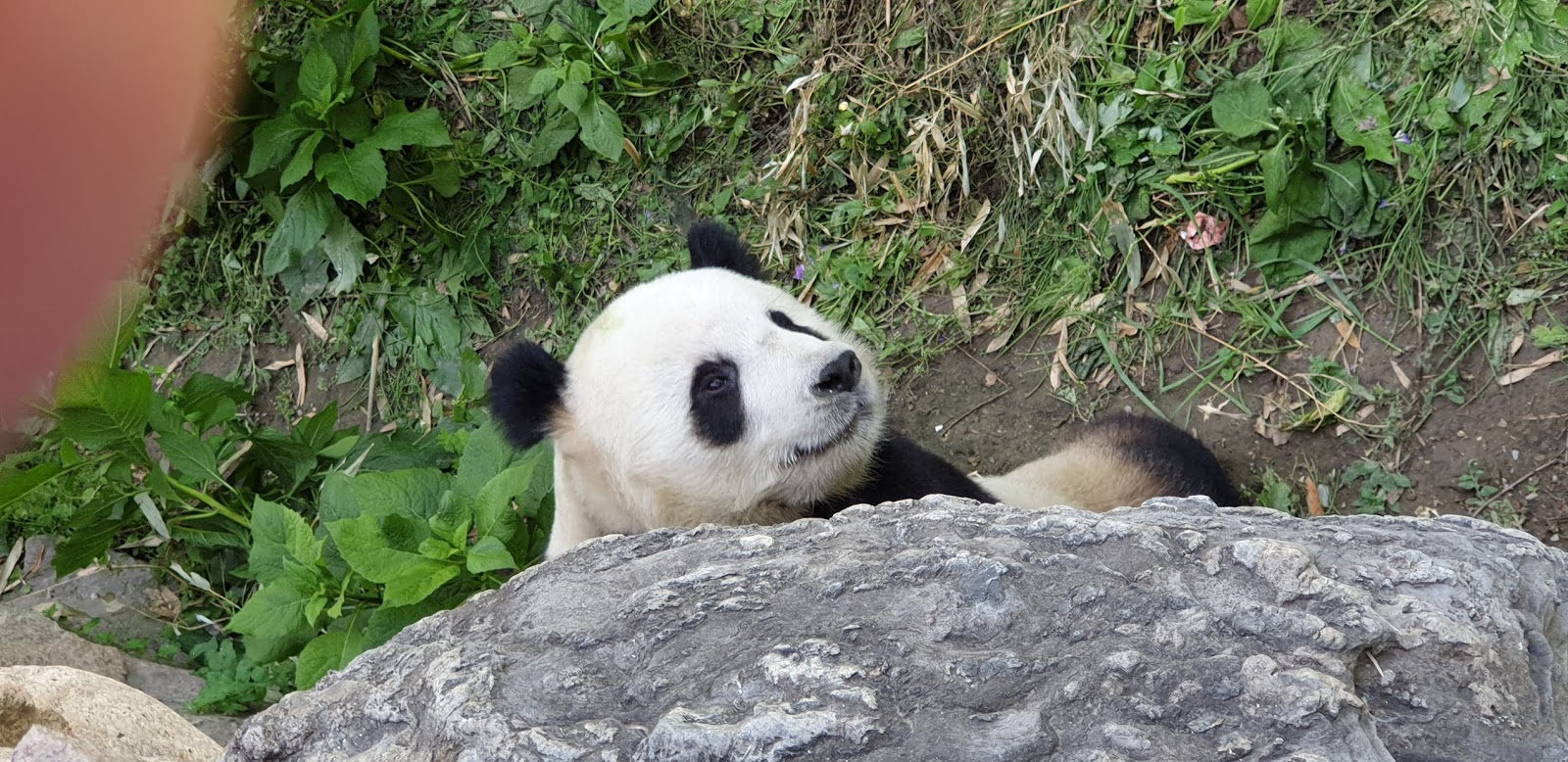
The hall itself is built on to the external enclosure where there are a number of giant pandas some of whom that were on show were relatively lethargic, as though they had a big weekend, and we're sleeping it off, like this panda below:

Then, remarkably, we came across one that decided to be a little more energetic and did a walk in front of hundreds of Chinese who had undoubtedly come to show their children the animals.


This Panda was also easier to photograph whereas the other panda, one chewing on a morning feast of bamboo, saw a lot of pushing and shoving by the spectators to get the best spot to take his photograph.  Having manners just doesn't cut it here, so do what you have to to get that photograph.


We also saw a couple of monkeys that were also in the panda enclosure, but they were not much of a side benefit.  They may have been there to use the Panda's exercise equipment, though it was not quite like what we use.
There was no time really to wander off to see much else, but apparently, there were also red pandas, and surprisingly, a category call Australian animals.  But, who goes to another country to view your own animals?
The cutest animals were the stuffed pandas, and they were quite reasonably priced.


Tuesday, June 11, 2019

A trip to China - Day 3 - Hutong, and a genuine Chinese meal


Hutong

The brochure says: In the afternoon, take the opportunity to join an optional tour (not included) to see Beijing’s 700-year-old Hutong’s (narrow lanes) area by old fashioned pedicab. You will also visit a local family living in a courtyard style home to experience the local customs including a delicious home-cooked dinner. 

The optional tour also includes a visit to Shichahai, a historic scenic area consisting of three lakes (Qianhai, meaning Front Sea; Houhai, meaning Back Sea and Xihai, meaning West Sea), surrounding places of historic interest and scenic beauty and remnants of old-style local residences, Hutong and Courtyard.  

First, we had a short walk through the more modern part of Hutong and given some free time for shopping, but we prefer just to meander by the canal.  


There is a lake, and if we had the time, there were boats you could take.


With some time to spare, we take a quick walk down one of the alleyways where on the ground level are small shops, and above, living quarters.


Then we go to the bell and drum towers before walking through some more alleys was to where the rickshaws were waiting.

The Bell tower


And the Drum tower. Both still working today.


The rickshaw ride took us through some more back streets where it was clear renovations were being made so that the area could apply for world heritage listing.  Seeing inside some of the houses shows that they may look dumpy outside but that's not the case inside.

The rickshaw ride ends outside the house where dinner will be served, and is a not so typical hose but does have all the elements of how the Chinese live, the boy's room, the girl's room, the parent's room, the living area, and the North-south feng shui.

Shortly after we arrive, the cricket man, apparently someone quite famous in Beijing arrives and tells us all about crickets


 and then grasshoppers, then about cricket racing.  He is animated and clearly enjoys entertaining us westerners.


I'm sorry but the cricket stuff just didn't interest me.  Or the grasshoppers.


As for dinner, it was finally a treat to eat what the typical Chinese family eats, and everything was delicious, and the endless beer was a nice touch.

And the last surprise, the food was cooked by a man.


Friday, June 7, 2019

A trip to China - Day 3 - The Great Wall of China, or part of it


The Great Wall of China

The brochure says, [After the Jade Museum], Afterwards take a scenic drive through the countryside and mountains to reach China’s most renowned monument—the Great Wall. You will visit the less-touristy and more original Juyong Pass, avoiding other sections which are the most accessible and consequently most crowded. The Great Wall meanders through China’s northern mountain ranges from the Yellow Sea to the Gobi Desert - a distance of more than 3500 miles. 

This is in a very scenic area and on the first impression; it is absolutely stunning in concept and in viewing.


As for the idea of walking on it, well, that first view of the mountain climb when getting off the bus, the first question was where the elevator is?  Sorry, there is none.  Its walk on up or stay down the bottom.


Walk it is.  As far as you feel you are able.  There is quite a few who don't make it to the top.  I didn't.  I only made it to the point where the steps narrowed.

But as for the logistics, there's the gradual incline to the starting point, and what will be the end meeting place.  From there, it's a few steps up to the first guard station no 7, and a few more to get up to the start of the main climb.  The top of the wall is guard station no 12.

Ok, those first few steps are a good indication of what it’s was going to be like and it's more the awkwardness of the uneven heights of the steps that's the killer, some as high as about 15 inches.  This photo paints an illusion, that it’s easy.  It’s not.


If you make it to the first stage, then it augers well you will get about 100 steps before you both start feeling it in your legs, particularly the knees, and then suffering from the height if you have a problem with heights as the air is thinner.  And if you have a thing with heights, never look down.


This was from where we stopped, about a third of the way up.  The one below, from almost at the bottom.  One we’re looking almost down on the buildings, the other, on the same level.


It requires rest before you come down, and that's when you start to feel it in the knees, our tour guide called it jelly legs, but it's more in the knees down.  Descending should be slow, and it can be more difficult negotiating the odd height steps, and particularly those high ones.  You definitely need to hang onto the rail, even try going backwards.

And, no, that rail hasn't been there as long as the wall.


While you are waiting for the guide to return to the meeting place at the appointed time, there should be time to have some jasmine tea.  Highly refreshing after the climb.

Lunch, today, is included, back at the jade factory

It is also a restaurant, and here we are being served Australia Chinese dishes that lean towards Chinese cuisine, but, it's definitely not authentic Chinese food.

I won't say it's disappointing because it tastes delicious, but I think it would have been more important to continue the Chinese experience.  Maybe that will come with the Hutong tour, which will be tonight.

With dinner included this should be the authentic Chinese food.

The trip back to Hutong was through the Olympic village where we saw the cube, for water sports and the bird's nest used for the opening and closing ceremonies, and several other stadiums, including the tennis, and archery, though this has been removed and is being replaced with an indoor ski centre.

Thursday, June 6, 2019

A trip to China - Day 3 - We're off to the Great Wall, via a Jade Factory


Day  3 - We're off to the great wall

The trip to the Great Wall is going to take a while and since we are leaving early, about 8:00 and the time for peak hour for traffic, it gives our guide some time to talk us about China, history and current day, and answer questions about everyday life in China.

It seems they do not have it any easier than we do when it comes to house prices, cost of living, taxes, petrol, cars, which are considerably more than we pay, children, education, though it might be rather less, child minding, and the usual government services like pension, hospital and other medical care, and the typical retirement age, which like in Australia, is increasing in age.

And it seems that life coexists somewhere between socialism and capitalism, which seems best for the country and its people.  Oppression and lack of individual freedoms doesn't match the impression we are given in the media, or from the odd case of infringement that occasionally hits our newspapers.

My view of China has changed significantly since being here. Of course, the internet is here, but without the usual social media platforms like Twitter and Facebook and the government might be responsible for making it impossible to use the internet in this hotel, but, I think its more of a bandwidth issue, and needs someone more qualified to fix it.  People don't look oppressed, they just look like you and me, dressed in formal wear or designer casual, and nearly everyone I saw under the age of 30 had a cell phone.

So much for social history, we are within a short distance and we are getting an introduction to the next place we're visiting.

On the way the Great Wall we are going via the jade museum, so called, but more a small factory and a very large sales showroom.  It's owned we're told by the government so there should be no problems with quality and after-sales service.  I doubt the Chinese government would want to have complaints levelled against it when this tour is a key part of many, many groups arranged by Trip a Deal.

Negative publicity has a way of destroying something very quickly, and the internet outside China is a very powerful determinant of what people will spend money on.  And Trip adviser is only too happy to help spread the word.

The Jade Factory

The brochure says today we will, after breakfast, on the way to the Great Wall, stop at a Jade Museum to learn the history of jade. In Chinese, jade is pronounced as “Yu” and it has a history in China of at least four thousand years. Observe the skilled artisans at work as they create their intricate designs.  I can’t wait.

But, first, you are dazzled by the ship and is nothing short of magnificent.


So, armed with the brief introduction, on the bus ride, and a story about how a jade bracelet saved a friend from serious harm by the tour guide, she hands us over to a local guide, read staff member, and she begins with a discussion on jade and we watch a single worker working on an intricate piece, sorry, there are two workers, and the second is working on a dragon.

Then it's into a smaller showroom and we are taken through the colours, and the carving process in the various stages, without really being told how the magic happens, then it's out into the main showroom where the sales are made, and before dispersing to look at the jade collection, she briefly tells us how to tell real and fake jade, and she does the usual trick of getting on of the tour group to model a piece.

Looks good, let's move on.  To bigger and better examples.


What interested me, other than the small zodiac signs and other smallish pieces on the 'promotion' table was the object tour guide told us about on the bus while stuck in a traffic jam, the good luck bangle.  If anyone needs one it is my other half, with all the medical issues and her sometimes clumsiness.

There are literally thousands of them, but, they have to be specially fitted to your wrist because if it's too large, you might lose it if it slips off and I didn't think it could be too small.  Nor is it cheap, and needing a larger size, it is reasonably expensive.  But it is jadeite, the more expensive of the types of jade, and it can only appreciate in value, not that we are interested in the monetary value, it's more the good luck aspect.

We could use some of that.

But, just to touch on something that can be the bugbear of travelling overseas, is the subject of happy houses, a better name for toilets, and has become a recurrent theme on this tour.  It's better than blurting out the word toilet and it seems there can be some not so happy houses given that the toilets in China are usually squat rather than sit, even for women.

And apparently, everyone has an unhappy house story, particularly the women, and generally in having to squat over a pit.  Why is this a discussion point, it seems the jade factory had what we have come to call happy happy houses which have more proper toilets, and a stop here before going on the great wall was recommended as the 'happy house' at the wall is deemed to be not so happy houses.


Not even this dragon was within my price range.  Thank heaven they had smaller more affordable models.

After spending a small fortune, another bonus, free Chinese tea.  Then it's onto the Great Wall experience.

Tuesday, June 4, 2019

A trip to China - Day 2 - On the way to the show, via the remnants of the wall around Beijing

Leaving the Square to go to the show, we pass remnants of the wall that used to surround Beijing


This wall was built in the early 15th century and was about 24 km long, up to 15 metres high and about 20 metres thick, and had nine gates, one of which still exists today.  In 1965 most of it was removed so that the second ring road and an underground railway line could be built.


Next, we're off to the show!


Billed as the best live show in China, described as a large scale dramatic musical, “The Golden Mask Dynasty” it lived up to its reputation and was thoroughly enjoyed by all.


It was not just singing dancing and acrobatics, it had a story and it was told so that language and cultural issues aside, it worked.  There was a narration of the story running beside the stage, but it was hard to divide attention between what was happening, and what was being related.


Then came the peacock dance, with live peacocks


And this was followed by a waterfall, well, I don't think anyone in that audience could believe what they were seeing.


I know I was both astonished and in awe of the performance.
What a way to finish off our first day in Beijing.
Oh, sorry, that high was dented slightly when we had to go back to our room.


A trip to China - Day 2 - On the way, and a visit, to Tiananmen Square

On the road to Tiananmen Square

One the first things you notice when driving around Beijing, other than the roads are congested with traffic, is the number of trees and flowers that have been planted, in the median strip as well as along the edges of the road.


And, then, every now and there, very colourful garden beds


Nearer to the square we are able to get up close to the flowers.  These, we are told, are a variation on the rose, one that flowers for nine months of the year.


They come in a variety of colours.


And they are literally everywhere you go, on the side of the roadway, sometimes blotting out the concrete jungle behind them.


Tiananmen Square

This is huge; one of the largest public squares in the world, and if you're going to walk it, like we did, make sure you've been exercising before you go.  It covers 44 hectares, borders on the Forbidden City, and has a memorial to chairman Mao in the centre of it.  But you cannot go near it, it's fenced off, and it is guarded.


That's both the statue and the square as there are random guards marching in random directions all the while watching us to see that we don't misbehave.
No one wants to find out what would happen if you jumped the fence around the statue, but I'm guessing you'll have a few years to contemplate the stupidity of your actions with some very unhappy government officials.
Around the edges of the square are huge buildings, one of which is the museum and the other is the Chinese equivalent of parliament.


Around the sides are also large gardens


At one end, where the Forbidden City borders on the square, there's a huge flag pole flying the Chinese flag, and this too like the monument is fenced off, and guarded by members of all of their armed services.  No tanks rolled out during our visit much to our disappointment.


Other than that, it's just another square, albeit probably one of the largest in the world.  It can, we were told, hold about a million people.


Monday, June 3, 2019

A trip to China - Day 2 - On our way to the Beijing Zoo to see the Pandas


Day 2 - The friendship hotel, building number 4

I don't think by the end of the stay the hotel finished up with any friends.  But it was probably good that we started with the oldest and most quirky of hotels, setting the tone of what we can expect, and hoping it could only get better.
The whole setting for the hotel is amazing, with buildings set in beautiful gardens.  The foyer was polished marble, cavernous and implied a luxury we expected.
By the time we got to our rooms all those expectations were shattered.  All show and no substance, it is an omen.  Even the passageways belied what was behind the doors.


Perhaps it would be better to label it as an army barracks because that's what some people said it reminded them of.
And the bed?
A 6 by 3-foot lump of five-ply board would have more give in it.  Don't try jumping up and down on these beds or you'll break a leg.
Our guide tells us that these sorts of beds are good for us.  Maybe if we had been using them since birth, but not when you're pushing 70.  So much for that Feng Shiu north-south thing which I find somewhat hard to understand.


Breakfast is in the Friendship Palace a room set aside that is rather like a barn with all the breakfast food arranged down the middle and tables scattered either side. 
One small observation which I thankfully noticed at the end of the stay was the carpet stains that emanated from under the food and spreading out towards the tables, no doubt made by food sliding off serving utensils and plates, and not being adequately cleaned after the hoards of trip a deal visitors were finished.
Perhaps whoever organises the accommodation might consider a better introduction to China that to have everyone starting with the impression Chinese hotels are small, cramped, and suffer from a basic lack of cleanliness.
After breakfast we assemble in the foyer ready to be taken on our first adventure, to negotiate Beijing traffic. 
Here is where we first learn about scooters, and the fact anyone can buy one, no licence needed, and for anyone else on the road, beware.  We soon learn why we are being cautioned to look in every direction before stepping onto a road.
And get to see the infamous Building No 4 in daylight.


Beijing Zoo

The sad truth is, an hour is too long if all you're going to see is the pandas.
Because apart from the idea of seeing pandas and in particular the giant pandas, there did not seem to be much more to see in the amount of time we had allocated. 
Another hour, maybe, might have made all the difference, but I think that extra time might have clashed with the pearl factory, and that, for obvious reasons, was deemed to be more important.
And, the giant pandas are far and few between, and those that were on show were relatively lethargic, as though the had a big weekend, and we're sleeping it off. 

Then, remarkably, we came across one that decided to be a little more energetic and did a walk in front of hundreds of Chinese who had undoubtedly come to show their children the animals.


This Panda was also easier to photograph whereas the other panda, one chewing on a morning feast of bamboo, saw a lot of pushing and shoving by the spectators to get the best spot to take his photograph.  Having manners just doesn't cut it here, so do what you have to to get that photograph.


We also saw a couple of monkeys that were also in the panda enclosure, but they were not much of a side benefit.
There was no time really to wander off to see much else, but apparently, there were also red pandas, and a number of other animal groups, and surprisingly, a category call Australian animals.  But, who goes to another country to view your own animals?
The cutest animals were the stuffed pandas, and they were quite reasonably priced.
Next...
Back on the bus, and off to the Longing pearl factory, you know the sort of place, the one where the tour guide gets a cut of every sale.

Longing Pearl Factory

As soon as you get in the door you are marshalled to an oyster shucker, who gives you a rundown on the different types and colour of pearls.
Then there's a demonstration, where an unsuspecting punter is selected to pick an oyster out of the tank, then there's the guessing game as to how many pearls are in the shell, with the winner getting a pearl.

Guesses ranged from 1 to 23 and the answer was 26.  Nearest wins, and one for the person who picked the oyster out of the tank.  Now with the punters suitably warmed up, we move on the ways we can tell the difference between real and fake pearls.
It seems strange that they would but we were guaranteed by both the tour guide and the lady delivering the lecture that the pearls we were about to buy were real, so how could we suspect there was anything dodgy about them?
And, just to let you know, the prices are very, very expensive, even if they say they have a special.