Showing posts with label Photography. Show all posts

Monday, March 22, 2021

Eating In, Peninsula Hotel, Hong Kong

Hotel dining can be a very expensive experience, but if you are there as one of those bucket list fulfillments like we were, then it's not unusual to go the whole nine yards.

Since the stay coincided with my birthday, the first day was set aside to have dinner at the Chinese restaurant upstairs and was one of those sublime experiences.  Of course, it had to be Peking Duck, expensive champagne, and several cocktails.

Oddly enough, breakfast wasn't included in the room rate, but that seems to be normal for a lot of hotels.  It can be if you want to pay upfront, but we don't always have breakfast, particularly if we have dinner the night before.

Or can be bothered getting out of bed the next morning because quite often the breakfast hours do go with staying in bed.

During this stay, we decided to have breakfast one morning, cereal, bacon and eggs, coffee, toast, you know, the usual stuff.


No paper placemats here and the silverware was just that, silverware.  This was going to be full on old world charm.


Coffee served from a silver coffee pot, fine bone china from Staffordshire, not Thailand, tea service for milk and sugar, condiments all in a row.

The only disappointment, I don't think the eggs were free-range.


And, when the conversation dries up, there's always a steady stream of people coming and going through the front door, and the doorman is always at the ready to open the door.


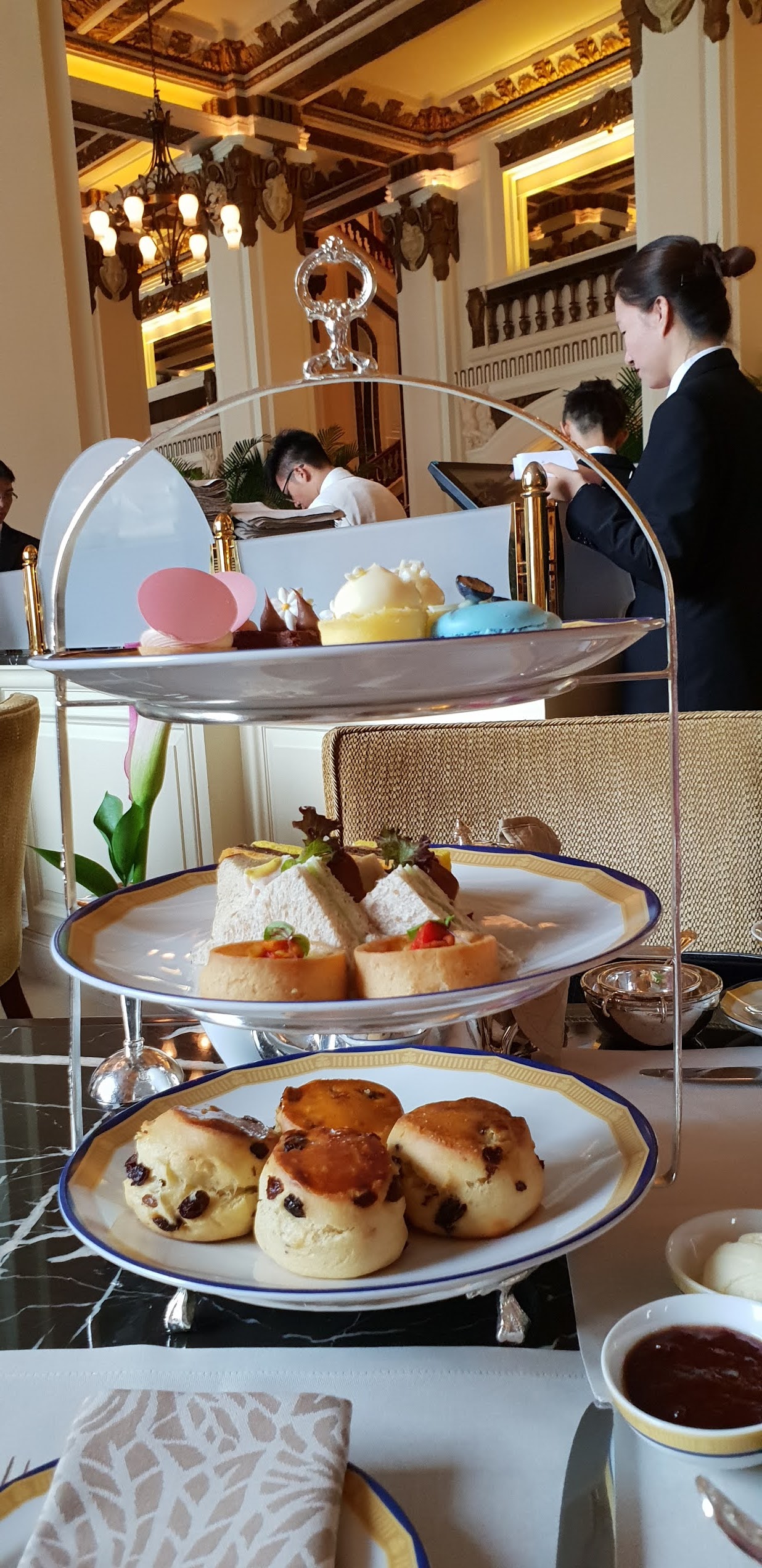
WE went once for lunch, and yes, we had to go to the famous Afternoon Tea, for which you had to book or stand in a very long line.  We booked and discovered preference was given to those who were staying at the hotel.


Out came the silver tea service, and one could imagine that this was the same as what it had been a hundred years ago.  I had tea, after all, it was afternoon tea!


The cakes were interesting, there were quarter sandwiches rather than finger sandwiches, and though I'm not a fan of fruit scones, I'm always up for something different.

After it, it's probably not a good idea to go out for dinner too.

Overall, the experience was worth it.


Tuesday, August 18, 2020

The Yu Gardens, Shanghai, China

The Yu Gardens or Yuyuan Gardens

The Yu Gardens (or Yuyuan Gardens) are located at No. 137, Anren Street, Huangpu District, very close to the Old City God Temple, in the northeast of the Old City of Shanghai at Huangpu.

Yu Garden was first built in 1559 during the Ming Dynasty by Pan Yunduan and finished approximately 1577, created specifically as a private garden of the Pan family for Pan Yunduan’s parents to enjoy in their old age.

Yu Garden occupies an area of 5 acres, and is divided into six general areas:

  -Sansui Hall which includes the Grand Rockery was originally used to entertain guests,

  -Wanhua Chamber is a delicate building surrounded by derious cloisters,

  -Dianchun Hall, built in 1820, includes Treasury Hall and the Hall of Harmony,

  -Huijing Hall which includes Jade Water Corridor.

  -Yuhua Hall which is furnished with rosewood pieces from the Ming Dynasty, and,

  -The Inner Garden with rockeries, ponds, pavilions, and towers; first laid out in 1709.  As the quietest part of Yu Gardens, it includes the Hall of Serenity and the Acting and Singing Stage.

The Mid-Lake Pavilion Teahouse, within the gardens, is the oldest teahouse in Shanghai.

A centerpiece of the gardens is the Exquisite Jade Rock, a 5-ton boulder that was originally meant for the Huizong Emperor (Northern Song Dynasty from 1100-1126 AD) but was salvaged from the Huangpu River after the boat carrying it had sunk.


These gardens house a lot of buildings that seemed to be a perfect blend of the old and the new, and if it was up to me, I’d keep the old.  Both the building and the gardens they are set in are like an oasis in the middle of an industrial complex, and perhaps impractical for the number of people living in Shanghai.


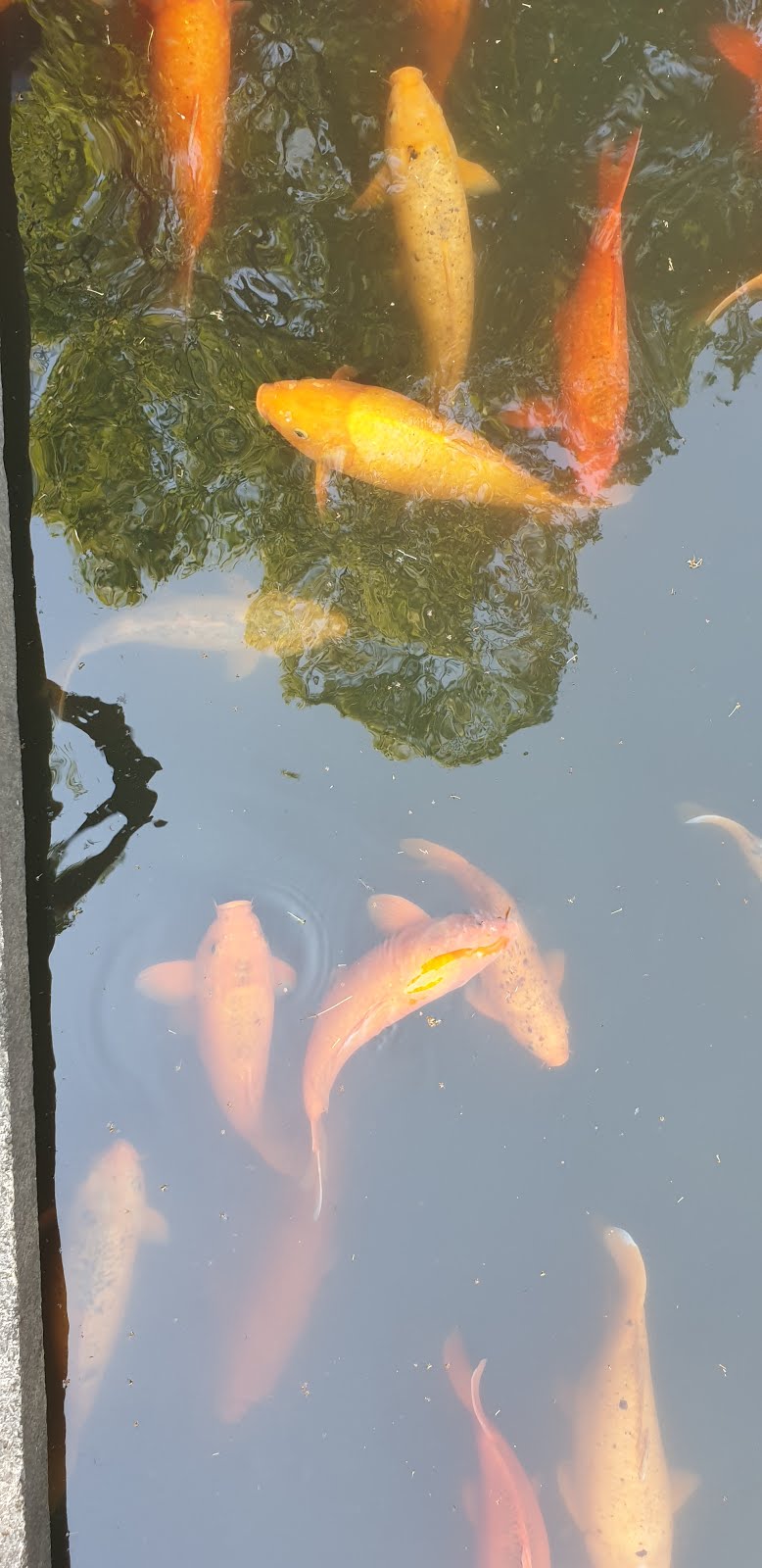
All of the ponds had a lot of fish in them


It was a pleasant afternoon, for both a stroll through the gardens


In and out of the rockery on narrow pathways


And to look inside the buildings that were sparsely furnished


There was even an area set aside for entertainment.


Old Shanghai, Shanghai, China

The old Shanghai refers to a small area of Shanghai that used to be walled in and remained that way until about 1912 when all but a small section of the wall was demolished.  With the advent of the concessions, Old Shanghai became the administrative center until later when it became a shopping complex.

Now it has many restored historical buildings as well as new buildings in a somewhat traditional style that has become one of Shanghai's main tourist attractions, housing many shops and restaurants.

The "Old Town" is not exclusively old, as you still have a chance to take in the atmosphere if you wander into the quaint side streets.

But, on first viewing walking down the street towards the complex, I'm not sure I'd go as far as to say this is in reality old Shanghai, except for what appears to be a true representation of it architecturally. 

The buildings, which are shops and restaurants, are set out symmetrically, with streets, alleyways, and squares which may prove that it was specially built for the tourists, and no mechanized traffic.


Anyway...

The buildings are magnificent, and a photographer's delight, and you'd finish up having hundreds of photos by the time you leave.  All the buildings are exquisite representations of traditional Chinese architecture. 


As for buying stuff, remember if you're not Chinese you have the sucker tourist stamp on your forehead, so be prepared to walk away if the vendors will not bargain.  

Nothing here is worth the price tag and in our group discounts like from 130 RMB to 50 RMB and from 1 for 1,200 to 2 for 950 RMB are common.

Here common t-shirts that we can get for 3 dollars back home start at 150 RMB which is roughly 35 dollars.  It's that kind of market.

We end up is a tea room, on the third floor of the meeting point below, and discover all the tour guides sitting around a table counting money, and I have to say it's the most $50 notes I've ever seen in one place.  

It is, we were told, where they discussed 'strategy'.

Friday, August 14, 2020

The French Quarter, Shanghai, China

The French Quarter and Shake Shack 

The Shanghai French Concession was a foreign concession in Shanghai, China from 1849 until 1943 and came to an end in 1943.  It was established on 6 April 1849, when the French Consul to Shanghai obtained a proclamation that conceded certain territory for a French settlement.

The area covered by the former French Concession remained the premier residential and retail district of Shanghai.

The French Quarter is an area west of the Bund, about 8km long comprising a number of small streets and is a highly desired area for non-Chinese to live.  Wukang Lu is a beautiful street, quaint and pretty, with outdoor cafes sprinkled here and there.  While on Wukang Lu, you wouldn't want to miss checking out Ferguson Lane on 376 Wukang Lu.  It is a charming pedestrian space with outdoor restaurants and wine bars.

If you're expecting a whole range of French restaurants forget it.  It's simply a collection of restaurants selling various types of food, and little else.

There is a shopping mall, further away from where the restaurants supposedly are, but there's little interest in finding them.  The happy house is far more important.

We settle, back in the French Quarter, in a place called the Shake Shack, located at No.10 Xintiandi North Block, Lane 181 Taicang Road, Huangpu District Xintindi 10-12 North Block, Shanghai, China.

I originally thought was the Snake Shack.  On closer inspection, and after being handed a menu, we discover it's a hamburger place.  Below is an idea of some of what the restaurant serves:

shakeshack

Is it like McDonald's, no.  The burger meat is real and the whole hamburger is absolutely delicious.  So are the fries, which are smallish well-cooked crinkle cut chips.

I had ice tea, which was real ice tea, not the sugary concoction you find in bottles, and the lemonade was real as well.

Value for money?  The prices were a little steep but, in my opinion, yes.  I'd go back again if I knew how to get there.


Monday, August 10, 2020

The Bund, Shanghai, China

The Bund

The architecture along the Bund or Waitan is a living museum of the colonial history of the 1800s.  The area centers on a section of Zhongshan Road within the former Shanghai International Settlement.

The word bund means an embankment or an embanked quay.   It was initially a British settlement; later the British and American settlements were combined in the International Settlement.

The Bund is a mile-long stretch of waterfront promenade along the Huangpu River. There are 52 buildings of various architectural styles, including Gothic, baroque, and neoclassical styles. The area is often referred to as "the museum of buildings". 

Building styles include Romanesque Revival, Gothic Revival, Renaissance Revival, Baroque Revival, Neo-Classical or Beaux-Arts, as well as a number in Art Deco style.

Having seen these buildings initially the night before, mostly lit up, our viewing this morning was from the land side, and particularly interesting in that the colonial architecture was really fascinating considering their location, but not surprising given Shanghai's history.  A lot of these buildings would be more at home in London, that out in the far east.


The Bund waterfront is about two kilometers long and impossible to cover in the time allowed for this part of the tour.


There was just enough time to get photos of the waterfront and the old buildings.


Some of these buildings had odd shapes, like one on the far right that looks like a bottle opener.


And, for some odd reason, a bull.


On the other side of the water, the sights that had been quite colorful the night before, were equally impressive though somewhat diminished by the haze.

Wednesday, August 5, 2020

The Maglev (Magnetic Levitation) Train, Shanghai, China

So, the first treat for the day is the high-speed magnetic train, something we only learned about after arriving in China and was not on any of the pre-tour documentation.

The train line connects Shanghai Pudong International Airport and Longyang Road Station (in the outskirts of central Pudong).  It is the oldest commercial maglev still in operation, and the first commercial high-speed maglev with cruising speed of 431 km/h (268 mph).  At full speed, the journey takes 7 minutes and 20 seconds to complete the distance of about 30 km.

Construction of the line began on March 1, 2001 and public services commenced on 1 January 2004.  It was built by a joint venture of Siemens and ThyssenKrupp from Kassel, Germany.

But, like visiting anything from a hotel, first we have to drive to the station and because we are leaving at 8, its peak hour traffic, and it takes 1 hour 10 minutes to get there.

The train also has a practical use and that is to take passengers from Shanghai to Pudong international airport as well as for those train enthusiasts, which is what we are.

On the train, it has the same sleek look as the bullet trains, but it is completely different, and you are able to see from the front of the train to the back.


Reputed to travel at 431 kph we take a seat and it is not long before the doors shut, and a loud humming noise is soon replaced by what sounds like an engine, then we start moving.  It sounds just like a normal train, and is a lot noisier than a normal bullet train.


Seating on the train was nothing special, as one might expect


It didn't take long before it hits the advertised speed of 431 kph.  This is not sustained for very long, because the distance is on 40 odd kilometers, and the whole trip takes about 7 minutes.


We go to the airport, and then we come back.  Is it worth the price, yes.  If you are a train enthusiast.


Tuesday, August 4, 2020

The Regal Plaza Hotel, Shanghai, China

Well, yet another grandiose exterior, and magnificent marble foyer.  Picture this...


Then, as always, the stars stop dropping off at the lifts, and then finally plunge when you get to the room.

Ours was designed by a blind man.


You open the door and it barely misses the end of the bed, there are two single beds in a room that would probably need an extra six inches if it was a king double.


You try to get past the end of the beds to what looks like an alcove but you walk into the TV, sticking about 8 inches out from the wall.

All in all, it's a very odd setup for a hotel room, but, again, it's not the first hotel we've stayed in where there is a shortage of space between walls and beds.  It was just disappointing that we ended up in a room with twin beds.

The next morning...

After the usual morning routine made somewhat more difficult because our room literally is a sardine can, we head down to breakfast and seize a seat at one of the round tables, one that is as stable as a paper house in an earthquake area.

Unlike the last hotel when there were 200 people trying to fit in a space that took 50, this time we can get breakfast and sit down, even if the table doesn't have cutlery or anything else on it.

There always seems to be a problem but I guess this morning we're using our hands.  But, as it happens somewhere in the room there must be spare knives and forks, other people are using them so we’ll add a little hide and seek to the morning's festivities.

The only thing I've found in China at breakfast time to be a problem is bacon.  They cannot seem to be able to cook it properly.  Perhaps it's the same with fried eggs, they seem to have this idea of cooking the yolk until it's hard.


Tuesday, July 28, 2020

Shanghai, China. A night cruise to the Bund and back


In Shanghai at last, and off to a boat ride at night


There's not enough time to go to the hotel and come back to the wharf, the hotel being about an hour's drive in the opposite direction to the cruise boat so we go to the boat ride parking lot instead, and take a half-hour or so before boarding to get something to eat.

When we finally get back from having a coffee or tea at a non-Starbucks coffee house, we find at least 100 buses all lined up and parked, and literally thousands of Chinese and other Asians streaming through the turnstiles to get on another boat leaving earlier than ours.

Buses were just continually stopping near where we were standing and literally arriving one after the other with people were everywhere in what could only be described as organized chaos.

At that moment, and even later, I was not quite sure what the name of the boat was, but it had 3 decks and VIP rooms and it was huge, with marble staircases.


Who has marble staircases in a boat?

We're going out across the water as far as the Bund and then turn around and come back about 30 to 40 minutes.   Being first on the boat we got the pick of the seats on the second of three levels and by the time everyone was on board, there was no room left on the third level, nor at the end of the second level.  And no one wanted to pay the extra to go into the VIP lounge.

We were sitting by very large windows where it was warm enough watching the steady procession of the colored lights of other vessels, and outside the buildings.


It was quite spectacular, as were some of the other boats going out on the harbour.

All the buildings of the Bund were lit up


And along that part of the Bund was a number of old English style buildings made from sandstone, and very impressive to say the least.

 
On the other side of the harbour were the more modern buildings, including the communications tower, as rather impressive structure.


And, another view of that communications tower:


Then, somewhat tired after a long day, next was the ride to the hotel, about 50 minutes or so, giving us enough time to consider the possibility that this hotel might be better than the last, but knowing full well those hopes were about to be dashed.


From Hangzhou to Shanghai, China.

Onwards, to Shanghai

From the brochure: Next, drive to Shanghai (approx. 2 hours) to visit the famous Bund. Shanghai is divided by the Huang Pu River into eastern and western sections. Modern mega high rises are seen on the eastern side while traditional European style architecture may be seen on the western side. The Bund is a five-block riverfront promenade with many of Shanghai's banks and trading houses.

We didn't do any of that, our guide deciding to change the order in which we would visit the various attractions in Shanghai.

We now have a 2 to 3-hour drive depending on traffic, to Shanghai with a happy house stop after 2 hours, which turned out to be a petrol station and a lot of little food places and a mini-mart.

Along the way I managed to get a photo of the fast train, a feat in itself considering the speed it was traveling:


We get a drink and bananas.

Of course, there were a lot of local products, some of which seems a little odd


I'm not sure what anyone would make of these, or some of the offerings inside the mall attached to the petrol station, but a lot of people declined the 'fast food' and piled into the grocery store, which was about the same as a Seven-Eleven store to stock up on items that might not affect their health.

I bought some very interesting drinks, or so my Chinese to English phone translator told me.

Monday, July 27, 2020

West Lake, Hangzhou, China. The gardens, and a cruise on the lake.

Next is our visit to the West Lake and surrounding gardens

West Lake is a freshwater lake in Hangzhou, China. It is divided into five sections by three causeways. There are numerous temples, pagodas, gardens, and artificial islands within the lake.

Measuring 3.2 kilometers (2 miles) in length, 2.8 kilometers (1.7 miles) in width, and 2.3 meters (7.5 feet) in average depth, the lake spreads itself in an area totaling 6.5 square kilometers (2.5 square miles).

The earliest recorded name for West Lake was the "Wu Forest River", but over time it changed to two distinct names.  One is "Qiantang Lake", due to the fact that Hangzhou was called "Qiantang" in ancient times.  The other, "West Lake", due to the lake being west of the city


It's about to get busy, with a number of activities planned, and the warmth of the day is starting to make an impact.

The tour starts in the car park about a kilometer away, but the moment we left the car park we were getting a taste of the park walking along a tree-lined avenue.


When we cross the road, once again dicing with death with the silent assassins on motor scooters.


We are in the park proper, and it is magnificent, with flowers, mostly at the start hydrangeas and then any number of other trees and shrubs, some carved into other flower shapes like a lotus.


Then there was the lake and the backdrop of bridges and walkways.

.

And if you can tune out the background white noise the place would be great for serenity and relaxation.


That, in fact, was how the boat ride panned out, about half an hour or more gliding across the lake in an almost silent boat, by an open window, with the air and the majestic scenery.


No, not that boat, which would be great to have lunch on while cruising, but the boat below:


Not quite in the same class, but all the same, very easy to tune out and soak it in.


It was peaceful, amazingly quiet, on a summery day


A pagoda in the hazy distance, an island we were about to circumnavigate.

Of all the legends, the most touching one is the love story between Bai Suzhen and Xu Xi'an. Bai Suzhen was a white snake spirit and Xu Xi'an was a mortal man.

They fell in love when they first met on a boat on the West Lake, and got married very soon after.

However, the evil monk Fa Hai attempted to separate the couple by imprisoning Xu Xi'an. Bai Suzhen fought against Fa Hai and tried her best to rescue her husband, but she failed and was imprisoned under the Leifeng Pagoda by the lake.

Years later the couple was rescued by Xiao Qing, the sister of Baisuzhen, and from then on, Bai Suzhen and Xu Xi'an lived together happily.

The retelling of the story varied between tour guides, and on the cruise boat, we had two.  Our guide kept to the legend, the other tour guide had a different ending.

Suffice to say it had relevance to the two pagodas on the far side of the lake.


There was a cafe or restaurant on the island, but that was not our lunch destination.


Nor were the buildings further along from where we disembarked.

All in all the whole cruise took about 45 minutes and was an interesting break from the hectic nature of the tour.

Oh yes, and the boat captain had postcards for sale.  We didn’t buy any.
 

Lunch


At the disembarkation point there was a mall that sold souvenirs and had a few ‘fast food’ shops, and a KFC, not exactly what we came to China for, but it seemed like the only place in town a food cautious Australian could eat at.


And when tried to get in the door, that's where at least 3 busloads were, if they were not in the local Starbucks.  Apparently, these were the places of first choice wherever we went.

The chicken supply by the time we got to the head of the line amounted to pieces at 22.5 RMB a piece and nuggets.  Everything else had run out, and for me, there were only 5 pieces left.  Good thing there were chips.

And Starbucks with coffee and cheesecake.

At least the setting for what could have been a picnic lunch was idyllic.