Showing posts with label Trees. Show all posts

Tuesday, May 26, 2020

The Forbidden City, Beijing, China

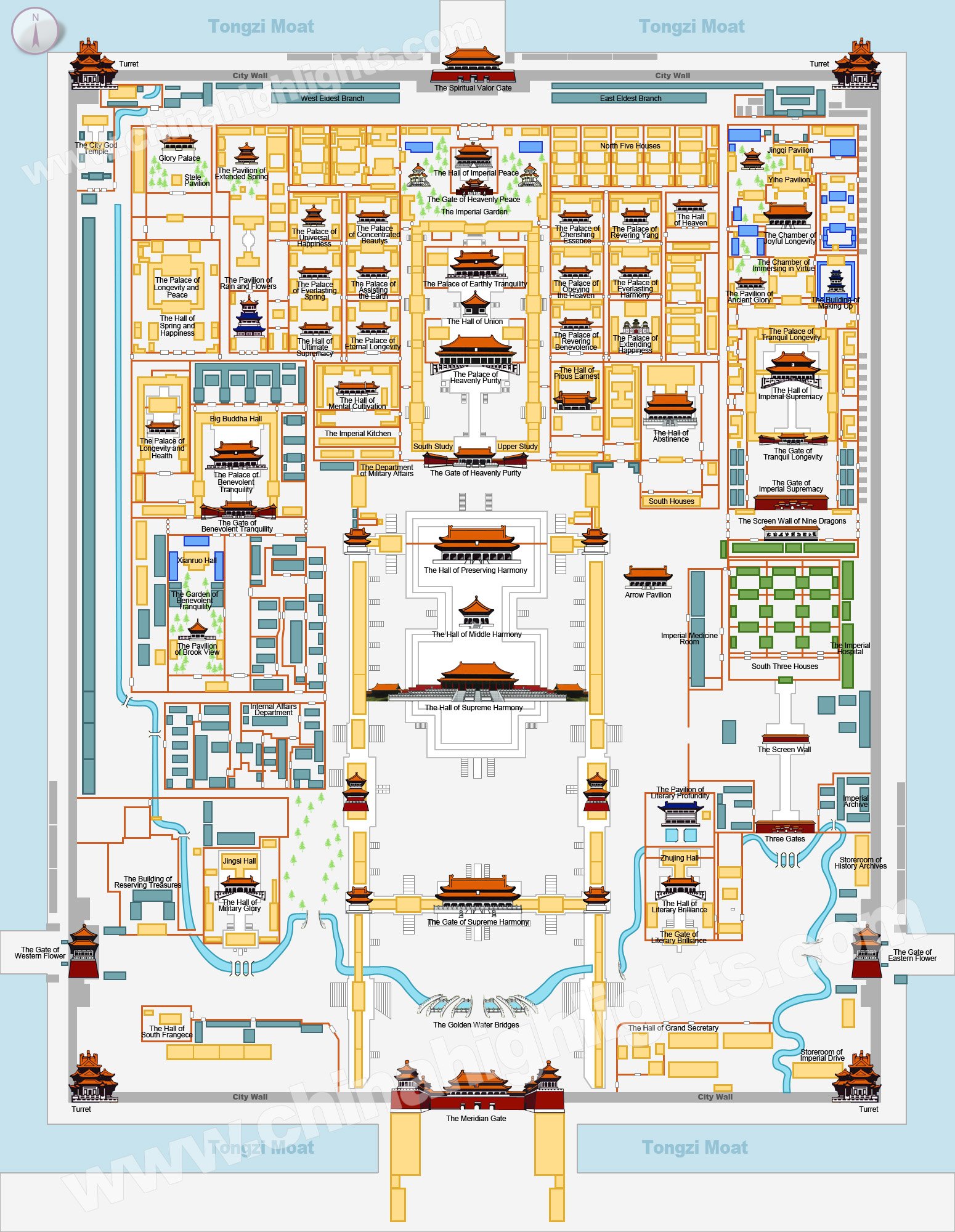
Now we're walking to the Forbidden City, and it seems like we're walking for miles and we're practically exhausted before we get started on the main tour.  I'm not sure if we received a map of the city, but one is certainly needed so that you can navigate the many features, buildings, and walkways.

There are tour groups everywhere in the large courtyard outside the gate, most likely getting a lecture on the last of the Chinese emperors about that time Sun Yat-Sen proclaimed the new China around 1912.  We were no exception, and it was an interesting way to spend the time waiting to get in.  It was a tale of intrigue, interwoven with a 3-year-old emperor, and a scheming concubine who becomes the Emperor's favorite, enough to bear him a son and successor.

Bribery and corruption at its best.

But its history runs something like this:

The Forbidden City is was once the imperial and state residence of the Emperor of China, as well as the center of government, from the Ming Dynasty to the Qing Dynasty, or 1420 to 1924.

It was built from 1406 to 1420 when the Yongle Emperor moved the capital from Nanking to Beijing and consists of about 980 buildings, and 8,886 bays of rooms (not the 9,999 as prescribed in myth) and covers 180 acres.  Over the 14 years, a million workers used whole logs of wood from the jungles of southwestern China, marble from quarries near Beijing, specially made golden bricks from Suzhou


Since 1925 it has been a museum and is the largest number of preserved wooden structures in the world.


The city is surrounded by a wall 7.9 meters high, and a moat that is 6 meters deep and 52 meters wide.  A tower sits at each of the four corners.  Each side has a gate, the north is called the Gate of Divine Might, the south is called the Meridian gate.  East and west are called East Glorious Gate and West Glorious Gate respectively.


But, back in the courtyard, we are ready to go in and follow the tour guide who has switched from her amplified microphone to a whisper device we all wear in our ears.  She talks and we listen.

We all make it through and regroup on the other side. This is where the fun begins because we are about to meet a large percentage of the 80,000, they let for the day.


It seems to me they have all arrived at the same time, although by the time we get to the entrance gate, it is very well organized, bags are scanned, people are scanned, and you're in.  

After crossing one of the seven Golden Water bridges, you begin to get some idea of the size and scope of the City, and in the distance, the first of the buildings, The Gate of Supreme Harmony.  On a hot day, that could be a long and thirsty walk.


From there it is one pagoda after another with buildings that surround the edge of the whole Forbidden City, as does the moat.


By the time we get to the second courtyard, it was time to have ice cream as a refresher.  Others head up to another exhibit, and it's just too many stairs for us.

After this, it's a walkthrough another courtyard, heading up and down some more stairs, we go and see the museum, with priceless relics from past emperors.


There are areas like the outer courtyard, the inner courtyard, yet another courtyard, and the gardens where the concubines walked and spent their leisure time.  It is not far from the emperor's wives living quarters, though there's precious little left of the furniture, other than a settee and two rather priceless so-called Ming dynasty vases.

We get into the bad habit of calling all of the vases Ming dynasties.  Above is one of the inner courtyards there were living quarters, and that tree is over 300 years old.


Out through some more alleyways and through an entrance that led to the area where the concubines lived, very spacious, bright, and filled with trees, plants, and walkways through rocky outcrops.


The whole area was made up of living quarters and waterways, rocks and paths, all very neatly set out, and it looked to be a very good place to live.


This is an example of the living quarters, overlooking the gardens

 And there were several pagodas


From there its a quick exit out the northern entrance, and another longish walk to our bus, which arrives at the meeting point shortly after we do.


That done, the Beijing tour guide has completed her section of our China experience, and we're ready to move onto the next, but not before getting onto the high-speed train and head for X'ian.

And a new tour guide by the name of Sam.

Tuesday, April 28, 2020

The remnants of the wall that surrounded Beijing, China


The fortification walls, both an inner wall and an outer wall, surrounding Beijing city were built from the early 1400s to 1553.
The dimensions of the Inner city wall are:
          Length: 24 kilometers or 15 miles
          Height: 25 meters or 49 feet high
          Thickness, at ground level: 20 meters or 66 feet
                            at the top: 12 meters or 29 feet
It had nine gates.  The fortifications included gate towers, archways, watchtowers, barbicans, barbican towers, sluice gates, sluice gate towers, enemy sighting towers, corner guard towers, and a moat system.
The outer city wall had a length of 28 kilometers or 17 miles.
From 1911, after the collapse of the Qing Dynasty, the dismantling of the fortifications began.

In 1965, major deconstruction of the fortifications was commenced to allow for the construction of the 2nd wrong road, and Line 2 or the Beijing underground railway.

 In 1979, the government called off the demolition of the remaining city walls and named them cultural heritage sites. By this time, the only intact sections were the gate tower and watchtower at Zhengyangmen, the watchtower at Deshengmen, the guard tower at the southeast corner, the northern moats of the Inner city, the section of the Inner city wall south of the Beijing railway station, and a small section of Inner-city wall near Xibianmen.


As for our guide's explanation of the fortifications:

Leaving the Square to go to the Golden Mask Dynasty Show, we pass remnants of the wall that used to surround Beijing.


This wall was built in the early 15th century and was about 24 km long, up to 15 meters high and about 20 meters thick, and had nine gates, one of which still exists today.  In 1965 most of it was removed so that the second ring road and an underground railway line could be built.


Monday, March 23, 2020

On the road to Tiananmen Square, Beijing, China


One the first things you notice when driving around Beijing, other than the roads are congested with traffic, is the number of trees and flowers that have been planted, in the median strip as well as along the edges of the road.


What you also notice is the large number of multi-story apartment blocks, which are needed to house the millions of Beijing residents.  What we have, so far, rarely seen, is single-story houses.
These continuous areas of trees and rose bushes are, every now and then, broken up by very colorful garden beds:


Nearer to the square we are able to get up close to the flowers.  These, we are told, are a variation on the rose, one that flowers for nine months of the year.


They come in a variety of colors.


And they are literally everywhere you go, on the side of the roadway, often blotting out the concrete jungle behind them.


Monday, June 17, 2019

A trip to China - Day 4 - It's time to leave Beijing and go to Xi'an


 This is the bus we had in Beijing


 Beijing train station.

This place is huge and there are so many people here, perhaps the other half of Beijing's population that wasn't at the forbidden city.

Getting into the station looked like it was going to be fraught with danger but the tour guide got us into the right queue and then arranged for a separate scanner for the group to help keep us all together


Then we decided to take the VIP service and got to waiting room no 13, the VIP service waiting room which was full to overflowing.  Everyone today was a VIP.  We got the red hat guy to lead us to a special area away from the crowd.

Actually, it was on the other side of the gate, away from the hoards sitting or standing patiently in the waiting room.  It gave us a chance to get something to eat before the long train ride.

Departure is at 4 pm, and the trains leave on time.  As it is a high-speed train, stops are far and few between, but we're lucky, this time, in that we don't have to count stations to know where to get off.

We're going to the end of the line.

A train ride with a difference

To make the 5 and a half hours go quicker we keep an eye on the speed which hovers between 290 and 305 kph, and sitting their with our camera waiting for the speed to hit 305 which is a rare occurrence, and then, for 306 and then for 307, which happened when we all took a stroll up to the restaurant car to find there had nothing to eat.

I got a strange flavoured drink for 20 yuan.

There was a lady manning a trolley that had some food, and fresh, maybe, fruit on it, and she had a sense of humour if not much English.

We didn't but anything but the barrel of caramel popcorn looked good.

The good thing was, after hovering around 298, and 299 kph, it finally hit 300.


We get to the end of the line, and there is an announcement in Chinese which we don't understand and attempts to find out if it is the last station fall on deaf ears, probably more to do with the language barrier than anything else.

Then, suddenly the train conductor, the lady with the red hat, comes and tell us it is, and we have fifteen minutes, so we're now hurrying to get off.

As the group were are scattered up and down the platform, we all come together and we go down the escalator, and, at the bottom, we see the trip a deal flags.

X’ian

This time we have a male guide, Sam, and have a few hiccups before we head to the bus.  Some of our travellers are not on his list, but with the other group.  Apparently a trip a deal mix up or miscommunication perhaps.

Then it's another long walk with bags to the bus.  Good thing its a nicely air-conditioned newish bus, and there's water, and beer for 10 yuan.  How could you pass up a tsing tao for that price?

Xi’an is a very brightly lit up city at night with wide roads.  It is very welcoming, and a surprise for a city of 10 million out in the middle of China.

As with all hotels, it's about a 50-minute drive from the railway station and we are all tired by the time we get there.

Tomorrow’s program will be up at 6, on the bus 8.40 and off to the soldiers, 2.00 late lunch, then train station to catch the 4.00 train, that will arrive at 2 hours later at the next stop.  A not so late night this time.

The Grand Noble Hotel

The Grand Noble Hotel, like the Friendship Hotel, had a very flash foyer with tons of polished marble.  It sent out warning signals, but when we got to our room, we found it to be absolutely stunning.  More room, a large bathroom, air conditioning the works.

Only one small problem, as in Beijing the lighting is inadequate.  Other than that it's what I would call a five-star hotel.  This one is definitely better than the Friendship Hotel. 

In the centre of the city, very close to the bell tower, one of the few ancient buildings left in Xi’an.  It is also in the middle of a larger roundabout and had a guard with a machine gun.

Sadly there was no time for city centre sightseeing.

Sunday, June 16, 2019

A trip to China - Day 4 - The Forbidden City

The Forbidden City

Now we're walking to the Forbidden City, and it seems like we're walking for miles and we're practically exhausted before we get started on the main tour.

There are tour groups everywhere in the large courtyard outside the gate, most likely getting a lecture on the last of the Chinese emperors about that time Sun Yat Sen proclaimed the new China around 1912.  It was a tale of intrigue, interwoven with a 3-year-old emperor, and a scheming concubine who becomes the Emperor's favourite, enough to bear him a son and successor.

Bribery and corruption at its best.


But, back in the courtyard, we are ready to go in and follow the tour guide who has switched from her amplified microphone to a whisper device we all wear in our ears.  She talks and we listen.

We all make it through and regroup on the other side. This is where the fun begins because we are about to meet a large percentage of the 80,000, they let for the day.


It seems to me they have all arrived at the same time, although by the time we get to the entrance gate, it is very well organised, bags are scanned, people are scanned, and you're in.  

From here, we have to cross one of the seven bridges leading to the outer courtyard.


From there it is one pagoda after another with buildings that surround the edge of the whole Forbidden City, as does the moat.


By the time we get to the second courtyard, it was time to have ice cream as a refresher.  Others head up to another exhibit, and it's just too many stairs for us.

After this, it's a walk through another courtyard, heading up and down some more stairs, we go and see the museum, with priceless relics from past emperors.


There are areas like the outer courtyard, the inner courtyard, yet another courtyard, and the gardens where the concubines walked and spent their leisure time.  It is not far from the emperor's wives living quarters, though there's precious little left of the furniture, other than a settee and two rather priceless so-called Ming dynasty vases.

We get into the bad habit of calling all of the vases Ming dynasties.  Above is one of the inner courtyards there were living quarters, and that tree is over 300 years old.


Out through some more alleyways and through an entrance that led to the area where the concubines lived, very spacious, bright, and filled with trees, plants, and walkways through rocky outcrops.


The whole area was made up of living quarters and waterways, rocks and paths, all very neatly set out, and it looked to be a very good place to live.


This is an example of the living quarters, overlooking the gardens

 And there were several pagodas


From there its a quick exit out the northern entrance, and another longish walk to our bus, which arrives at the meeting point shortly after we do.


That done, the Beijing tour guide has completed her section of our China experience, and we're ready to move onto the next, but not before getting onto the high-speed train and head for X'ian.

And a new tour guide by the name of Sam.


Friday, June 14, 2019

A trip to China - Day 4 - Before going to the Forbidden City, it's time for TCM


Day 4 - The Forbidden City

This morning I get up early and get a few photos of the hotel grounds before breakfast.  After all, it is advertised as being spread over 335,000 square metres of which 200,000 square metres are of gardens in the traditional Chinese style


Roads through the hotel grounds were wide enough for the bus to reach our building


Even to the point where there was a roundabout


Tongrentang – Traditional Chinese Medicine

Before we arrive at the Forbidden City we have an appointment with the doctors at the centre for traditional Chinese medicine, or T C M.

It's the same people who tended to the emperor way back, and scored some land to build a facility to bring that medicine to the people.

The prices they charge, there is no way 99 per cent of the population could afford it, only us gullible westerners.  Still, it looks might work so I joined the list of gullible people to give it a go.

What was the diagnosis?  Heart, liver, apparently the same as everyone else, but he did mention thyroid which is not a common problem, so it looks like there might be a grain of truth to it to his medical wisdom.

We shall see.

What worries me is that all the pillboxes look the same, and as the writing is in Chinese there's no way of telling if they are or not.


There was a chart on the wall that accompanied the introduction to Chinese Medicine given by a Professor, or a Doctor, I was not sure which, who told us how everything was linked in groups, as shown above, what ailments were related, and how treatments were formulated.

I was glad, in the end, my problems were only related to the Heart and the liver, mostly because of my type of arthritis.

So much for T C M


Tuesday, June 11, 2019

A trip to China - Day 3 - Hutong, and a genuine Chinese meal


Hutong

The brochure says: In the afternoon, take the opportunity to join an optional tour (not included) to see Beijing’s 700-year-old Hutong’s (narrow lanes) area by old fashioned pedicab. You will also visit a local family living in a courtyard style home to experience the local customs including a delicious home-cooked dinner. 

The optional tour also includes a visit to Shichahai, a historic scenic area consisting of three lakes (Qianhai, meaning Front Sea; Houhai, meaning Back Sea and Xihai, meaning West Sea), surrounding places of historic interest and scenic beauty and remnants of old-style local residences, Hutong and Courtyard.  

First, we had a short walk through the more modern part of Hutong and given some free time for shopping, but we prefer just to meander by the canal.  


There is a lake, and if we had the time, there were boats you could take.


With some time to spare, we take a quick walk down one of the alleyways where on the ground level are small shops, and above, living quarters.


Then we go to the bell and drum towers before walking through some more alleys was to where the rickshaws were waiting.

The Bell tower


And the Drum tower. Both still working today.


The rickshaw ride took us through some more back streets where it was clear renovations were being made so that the area could apply for world heritage listing.  Seeing inside some of the houses shows that they may look dumpy outside but that's not the case inside.

The rickshaw ride ends outside the house where dinner will be served, and is a not so typical hose but does have all the elements of how the Chinese live, the boy's room, the girl's room, the parent's room, the living area, and the North-south feng shui.

Shortly after we arrive, the cricket man, apparently someone quite famous in Beijing arrives and tells us all about crickets


 and then grasshoppers, then about cricket racing.  He is animated and clearly enjoys entertaining us westerners.


I'm sorry but the cricket stuff just didn't interest me.  Or the grasshoppers.


As for dinner, it was finally a treat to eat what the typical Chinese family eats, and everything was delicious, and the endless beer was a nice touch.

And the last surprise, the food was cooked by a man.