Showing posts with label Ancient Ruins. Show all posts

Tuesday, June 30, 2020

The Pagoda Forest, near Zhengzhou City, Henan Province, China

The pagoda forest

After another exhausting walk, by now the heat was beginning to take its toll on everyone, we arrived at the pagoda forest.

A little history first:

The pagoda forest is located west of the Shaolin Temple and the foot of a hill.  As the largest pagoda forest in China, it covers approximately 20,000 square meters and has about 230 pagodas build from the Tang Dynasty (618-907) to the Qing Dynasty (1644-1911).

Each pagoda is the tomb of an eminent monk from the Shaolin Temple.  Graceful and exquisite, they belong to different eras and constructed in different styles.  The first pagoda was thought to be built in 791.

It is now a world heritage site.


No, it's not a forest with trees it's a collection of over 200 pagodas, each a tribute to a head monk at the temple and it goes back a long time.  The tribute can have one, three, five, or a maximum of seven layers.  The ashes of the individual are buried under the base of the pagoda.

The size, height, and story of the pagoda indicate its accomplishments, prestige, merits, and virtues. Each pagoda was carved with the exact date of construction and brief inscriptions and has its own style with various shapes such as a polygonal, cylindrical, vase, conical and monolithic.


This is one of the more recently constructed pagodas


There are pagodas for eminent foreign monks also in the forest.

From there we get a ride back on the back of a large electric wagon


to the front entrance courtyard where drinks and ice creams can be bought, and a visit to the all-important happy place.


Then it's back to the hotel.

Tuesday, May 5, 2020

The Great Wall of China, near Beijing, China

The Great Wall of China

After visiting the jade factory we take a scenic drive through the countryside and mountains to reach China’s most renowned monument—the Great Wall. 
We were visiting the less-touristy and more original Juyong Pass, avoiding other sections which are the most accessible and consequently most crowded. 
From a short discussion on the bus while traveling to this destination we learn the Great Wall meanders through China’s northern mountain ranges from the Yellow Sea to the Gobi Desert - the original wall's actual distance was about 21,196 km or 13,170 miles. 
Currently, it is about 8,850 km or 5,500 miles, 6 to 7 meters high, 20 to 23 feet.  The average width is about 6.5 meters or 21.3 feet.  Though originally the wall was started 2,700 years ago, the sections set aside for visitors are between 400 to 600 years old.
And the wall isn't just a wall, it had a host of other fortifications such as overlapping walls, trenches, watchtowers and beacon towers for communications, fortresses, and barracks to accommodate soldiers.

This is in a very scenic area and on the first impression; it is absolutely stunning in concept and in viewing.


As for the idea of walking on it, well, that first view of the mountain climb when getting off the bus, my first question was where the elevator is?  Sorry, there is none.  It's walk on up or stay down the bottom.


Walk it is.  As far as you feel you are able.  There are quite a few who don't make it to the top.  I didn't.  I only made it to the point where the steps narrowed.

But as for the logistics, there's the gradual incline to the starting point, and what will be the end meeting place.  From there, it's a few steps up to the guard station no 7, and a few more to get up to the start of the main climb.  The top of the wall is guard station no 12.

Ok, those first few steps are a good indication of what it’s was going to be like and it's more the awkwardness of the uneven heights of the steps that's the killer, some as high as about 15 inches.  This photo paints an illusion, that it’s easy.  It’s not.


If you make it to the first stage, then it augers well you will get about 100 steps before you both start feeling it in your legs, particularly the knees, and then suffering from the height if you have a problem with heights as the air is thinner.  And if you have a thing with heights, never look down.


This was from where we stopped, about a third of the way up.  The one below, from almost at the bottom.  One we’re looking almost down on the buildings, the other, on the same level.


It requires rest before you come down, and that's when you start to feel it in the knees, our tour guide called it jelly legs, but it's more in the knees down.  Descending should be slow, and it can be more difficult negotiating the odd height steps, and particularly those high ones.  You definitely need to hang onto the rail, even try going backward.

And, no, that rail hasn't been there as long as the wall.


While you are waiting for the guide to return to the meeting place at the appointed time, there should be time to have some jasmine tea.  Highly refreshing after the climb.

Lunch, today, is included, back at the jade factory

It is also a restaurant, and here we are being served Australia Chinese dishes that lean towards Chinese cuisine, but, it's definitely not authentic Chinese food.

I won't say it's disappointing because it tastes delicious, but I think it would have been more important to continue the Chinese experience.  Maybe that will come with the Hutong tour, which will be tonight.

With dinner included this should be the authentic Chinese food.


Tuesday, April 28, 2020

The remnants of the wall that surrounded Beijing, China


The fortification walls, both an inner wall and an outer wall, surrounding Beijing city were built from the early 1400s to 1553.
The dimensions of the Inner city wall are:
          Length: 24 kilometers or 15 miles
          Height: 25 meters or 49 feet high
          Thickness, at ground level: 20 meters or 66 feet
                            at the top: 12 meters or 29 feet
It had nine gates.  The fortifications included gate towers, archways, watchtowers, barbicans, barbican towers, sluice gates, sluice gate towers, enemy sighting towers, corner guard towers, and a moat system.
The outer city wall had a length of 28 kilometers or 17 miles.
From 1911, after the collapse of the Qing Dynasty, the dismantling of the fortifications began.

In 1965, major deconstruction of the fortifications was commenced to allow for the construction of the 2nd wrong road, and Line 2 or the Beijing underground railway.

 In 1979, the government called off the demolition of the remaining city walls and named them cultural heritage sites. By this time, the only intact sections were the gate tower and watchtower at Zhengyangmen, the watchtower at Deshengmen, the guard tower at the southeast corner, the northern moats of the Inner city, the section of the Inner city wall south of the Beijing railway station, and a small section of Inner-city wall near Xibianmen.


As for our guide's explanation of the fortifications:

Leaving the Square to go to the Golden Mask Dynasty Show, we pass remnants of the wall that used to surround Beijing.


This wall was built in the early 15th century and was about 24 km long, up to 15 meters high and about 20 meters thick, and had nine gates, one of which still exists today.  In 1965 most of it was removed so that the second ring road and an underground railway line could be built.


Tuesday, November 13, 2018

Siena, Tuscany, Italy, the Palio and pasta

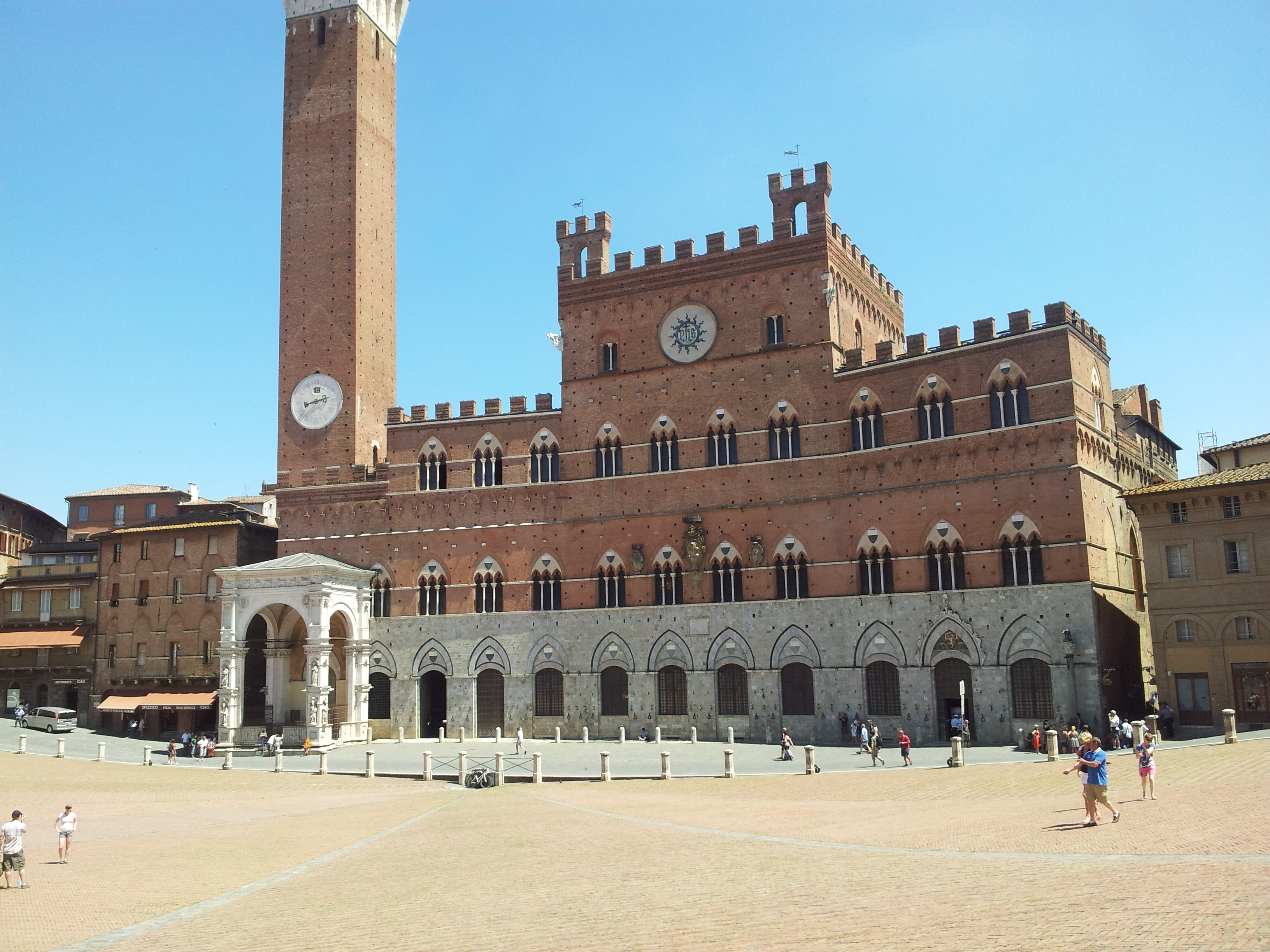
This is the Piazza del Campo. with the Palazzo Pubblico, the Gothic town hall, and the Torre del Mangia, a 14th-century tower.

Here we were, sitting at a restaurant, waiting for the Palio, a traditional medieval horse race run around the Piazza del Campo.

We were a week late.

There's always next year.

Not all was lost though, the spinach and ricotta ravioli was to die for.

20130619_143443

I might add, the day was very hot, and in the middle of all that stone paving and brick walls, the heat was magnified and felt like what it might be inside an oven.

Oh, what I would have given for a cool breeze!


Wednesday, October 24, 2018

Rome - August is not the time of year to go there

We visited Rome in August

It was hot.

It was verrrry hot.

We flew into Rome's Leonardo da Vinci-Fiumicino airport after a rather bumpy flight from London.  Unlike most other airports the plane parked at a satellite terminal and after we disembarked we had to catch a train to the main terminal.

The most notable memory of this airport was my daughter’s discovery of a salami shop.
We had booked a transfer to take us to the hotel the Roma Corso Trieste Mercure in Via Gradisca from the airport.  It was a white air-conditioned van and so far we had avoided the heat.
One of the rooms had a faulty air conditioning an absolute must as the rooms were very hot without it and necessitated a room change which was done quickly and efficiently.

The hotel was in the suburbs and without a car we were dependent on public transport.  According to the reception staff, there was a bus stop nearby, and a longer walk to the tram or light railway.  The bus seemed to be the best option as it would take us to the central terminal near the railway station, where all tour buses also operated from, and particularly the open top buses that went to all the major tourist attractions.

That first day basically was given over to traveling, arriving by plane and settling into the hotel, thus we didn't get to feel the force of the heat.  That came the next day.

After a walk around the hotel precinct to get our bearings and see what shops and restaurants were available, on returning to the hotel we were faced with the limited choices of room service or to go out for dinner.

My daughter and l go for a long walk up Via Nomentana to find several shops and a restaurant.  We went into the restaurant and sat down.   We waited for 10 minutes and got no service nor did anyone come and ask us if we wanted to order food so instead we left somewhat disappointed and go next door to what seems to be the Italian version of a delicatessen and order sandwiches and beer.   I bought a half dozen cans of Moretti beer two of which I drank on the way home.

It was still very hot even at eight at night and the sandwiches are delicious.  It just might be by that time we were starving and anything would have tasted great.

The next morning we are up and ready to chance the weather and some history.  Breakfast at the hotel is limited but very good.

We were going to use public transport and I'd studied up on the Internet.

Traveling on the bus required pre-purchase of tickets which could be bought in certain shops and locally when exploring the area near the hotel, l found a tobacconist.

Next, we needed to understand how to use the tickets. There was no one on the bus who could help so when l tried to scan the tickets and it failed, l gave up.  We had the same issue each day and in the end, the tickets never got used.

The trip to central Rome by bus took about 15 minutes.  In the morning it was reasonably cool and showed us a little of suburban Rome.  We also saw the trams but we would not be able to use them because our hotel not on a direct route.

That first full day we decided to go and see the Vatican.

Not understanding buses and which one we needed to get to the Vatican, we took a taxi.
Wow.  It was the metaphorical equivalent of driving over the edge of a cliff with a daredevil.  It was quite literally terrifying.

Or maybe we just didn't know that this was probably the way people drove in Rome.
Shaken but delivered in one piece we found ourselves in the square opposite St Peters Basilica.
The square is impressive, with the statues atop a circular colonnaded walkway.  The church is incredible and took a few hours to take in and to top off the day, we did a tour of the Vatican museum which took the rest of the afternoon.

Then it was back to the delicatessen for more sandwiches and beer, and an interesting discussion with several elderly Italian ladies, of which I did not understand one word.

The second full day we decided to use one of the open top bus tours and eventually decided on the hop on hop off tour simply because the bus was at the central transport terminal for trains and buses and it was getting hotter.

Our first stop was the Colosseum.  There were other monuments nearby, such as the Arch of Constantine, but as the heat factor increased we joined the queue to go into the Colosseum and gladly welcomed the shade once we got inside.

The queue was long and the wait equally so, but it was worth the wait.  It would be more interesting if they could restore part of it to its former glory so we could get a sense of the place as it once was.  But alas that may never happen, but even so, it is still magnificent as a ruin.

Outside in the heat, it was off to the ruins which were a longish walk from the Colosseum, taking Via Sacra, not far from the Arch of Constantine.  This day in the walkway there were a number of illegal vendors, selling knockoff goods such as handbags and watches, and who, at the first sight of the police, packed up their wares in a blanket and ran.

Included in these ruins were The Roman Forum, or just a few columns remaining, the Palatine Hill, Imperial Fori, including the Forum of Augustus, the Forum of Caesar, and more specifically the Forum of Trajan.  It was, unfortunately very hot and dusty in the ruins the day we visited.
We walked all the way to the Foro Romano and the Septimus Severo Arch at the other end of the ruins, past the Temple of Caesar.

I found it very difficult to picture what it was like when the buildings were intact, so I bought a guide to the ruins which showed the buildings as ruins and an overlay of how they would have looked.  The buildings, then, would be as amazing as the Colosseum, and it would have been interesting to have lived back then, though perhaps not as a Christian.

I lost count of the number of bottles of water we bought, but the word ‘frizzante’ was ringing in my ears by the end of the day.  Fortunately, the water did not cost a lot to buy.

At the end of the day, we caught the hop on hop off bus at the Colosseum and decided not to get off and see any more monuments but observe them from the bus.  The only one I remember seeing was Circo Massimo.  Perhaps if we’d know it was going to be twice as hot on the bus, yes, there was no air-conditioning; we may have chosen another form of transport to get back to the hotel.

The third and last day in Rome we decided to go to the Trevi Fountain, see the pantheon and walk up the Spanish Steps.  We spent most of the morning in the cool of a cafĂ© watching the tourists at the fountain.  By the time we reached the top of the Spanish Steps, we were finished.

It was time to move on to Paris.